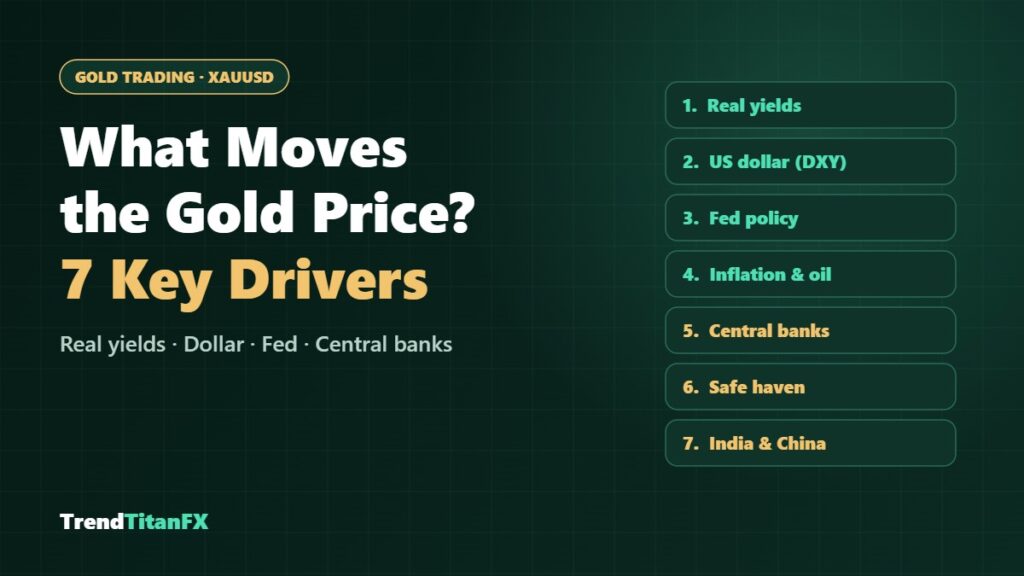
Gold (XAUUSD) is driven mainly by real interest rates, the US dollar and Fed expectations, with central bank buying, inflation, safe-haven demand and physical demand from India and China working in the background. 2026 shows how it works in practice: gold hit a record of about $5,595 in January, then fell to around $4,000 as US yields climbed to 5% and the Fed turned hawkish.
Why gold moves differently from currencies
Gold pays no interest and has no central bank of its own. Its price in dollars reflects one question: is holding a non-yielding asset more or less attractive than holding cash and bonds right now? Almost every driver below changes the answer to that question.
The 7 drivers of the gold price
1. Real interest rates (the big one)
A real rate is a bond yield minus inflation. When real rates rise, investors can earn a safe, inflation-beating return in bonds, so gold looks expensive to hold. When real rates fall, gold’s lack of interest matters less. Traders track the 10-year TIPS yield (code DFII10 on the St. Louis Fed’s free FRED site) as a live gauge.
2026 example: the 10-year Treasury yield climbed back into the 5% range this autumn, one of the main reasons gold fell more than 26% from its January peak (Seoul Economic Daily).
2. The US dollar
XAUUSD is priced in dollars. When the dollar strengthens, an ounce of gold costs fewer dollars, and it becomes more expensive for buyers paying in euros, rupees or yuan. A rising US Dollar Index (DXY) is usually a headwind for gold, and a falling one a tailwind. The link is strong but not perfect: during a crisis, both can rise together as investors look for safety.
3. Fed policy and expectations
The Fed moves both real rates and the dollar, so its decisions matter twice. What counts is the surprise, not the decision itself. In October 2026 the Fed held rates at 3.75%–4.00%, which was expected, so gold barely moved. The bigger factor is the market’s pricing of a possible December hike. We covered this in detail in Gold after the Fed hold.
4. Inflation, and oil as its fuel
Gold is often called an inflation hedge, but the effect depends on how the Fed reacts. If inflation rises and the Fed hikes hard, real rates go up and gold can fall. That is exactly what happened this year: higher oil prices lifted inflation fears, pushed yields up and weighed on gold, even though “inflation is high” sounds bullish.
5. Central bank buying
Central banks have been steady buyers since 2022. In August 2026 alone they reported net purchases of 39 tonnes, bringing the year-to-date total to 170 tonnes, with Poland (98t) and China (80t) the biggest buyers this year (World Gold Council). This buying rarely moves the price day to day, but it puts a floor under dips and explains why gold held up in past high-rate periods.
6. Safe-haven demand and geopolitics
Wars, banking stress and political shocks usually send money into gold. But the effect can cut both ways. In 2026, conflict in the Middle East pushed oil higher, which raised inflation fears and Treasury yields, and that hurt gold more than the safe-haven demand helped it (Reuters via Yahoo Finance).
7. Physical and ETF demand
Jewellery, bar and coin demand from India and China, plus flows into gold ETFs, add or remove buying pressure over weeks and months. StoneX analyst Rhona O’Connell expects “steady improved physical demand from India and China” to help support prices.
Cheat sheet: what usually helps or hurts gold
| Driver | Usually bullish for gold | Usually bearish for gold | Where to check |
|---|---|---|---|
| Real yields | Falling | Rising | 10-year TIPS yield (FRED: DFII10) |
| US dollar | Weakening | Strengthening | DXY chart |
| Fed | Dovish surprise, cuts | Hawkish surprise, hikes | CME FedWatch, Fed statements |
| Inflation | Rising, with a slow Fed | Rising, with an aggressive Fed | CPI, PCE releases |
| Central banks | Heavy buying | Net selling | World Gold Council monthly stats |
| Geopolitics | Fear, financial stress | Shocks that lift yields and oil | News, oil price |
| Physical / ETF | Inflows, festival demand | Outflows | ETF holdings data |
Case study: why gold fell from its 2026 record
- January: gold peaks at about $5,595.
- Through the year: conflict in the Middle East pushes oil up, inflation fears return and Treasury yields rise.
- September: the Fed raises rates by 0.25% to 3.75%–4.00%.
- October: the 10-year yield trades around 5%, the Fed holds but keeps a December hike on the table, and gold trades near $4,000–$4,050.
Analysts polled by Reuters now see gold averaging $4,495 in 2026 and $4,650 in 2027, and point to central bank buying and physical demand as the main sources of support.
How to use this before you trade gold
- Check the dollar and yields first. If DXY and the 10-year yield are both rising, be cautious with buys.
- Know the calendar. CPI, PCE, jobs data and Fed days can move gold by tens of dollars in minutes. See the best time to trade gold.
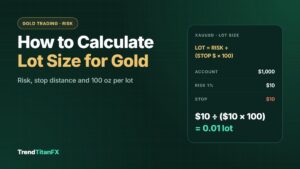
- Trade the technicals, size from the risk. The drivers set the backdrop; your entry and stop still come from the chart. Size every trade with the lot size calculator.
FAQ
What is the single biggest factor for gold prices?
Real interest rates. When the return on safe, inflation-protected bonds rises, gold usually struggles; when it falls, gold usually rallies.
Why does gold go down when the dollar goes up?
Gold is priced in dollars, so a stronger dollar means fewer dollars per ounce and makes gold more expensive for buyers using other currencies.
Is gold a good hedge against inflation?
Over long periods, often yes. In the short term it depends on the Fed: if inflation leads to aggressive rate hikes, gold can fall, as it did in 2026.
Do central banks really affect the gold price?
Yes, mainly over months and years. Steady central bank buying adds demand that supports prices during dips, even when rates are high.