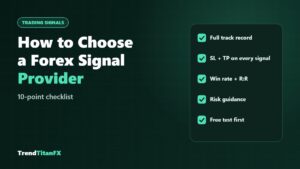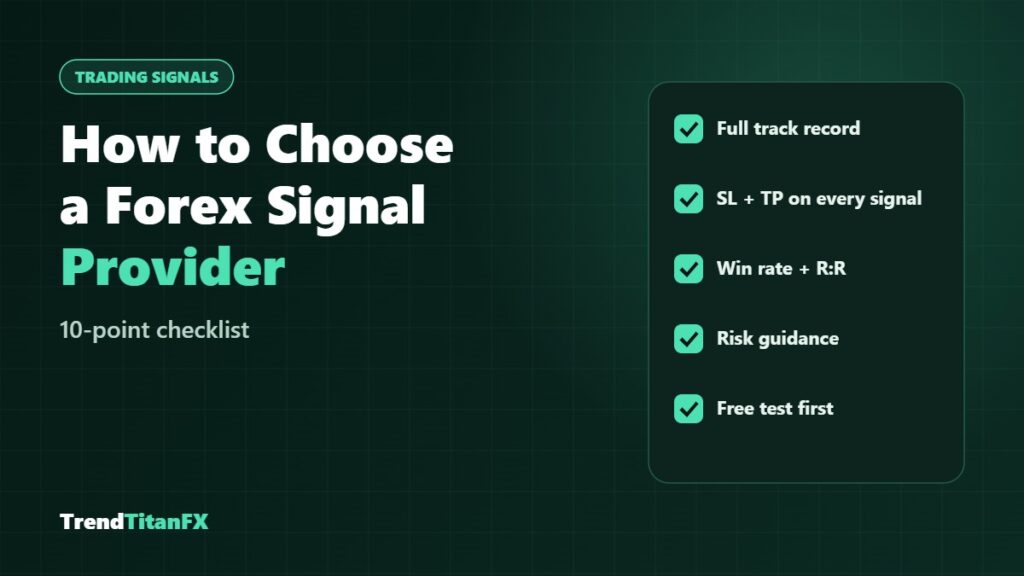
Choose a forex signal provider that shows a full, dated track record including losses, gives a stop loss and take profit on every signal, explains risk per trade, trades markets and hours that fit you, and lets you test for free before paying. A high win rate on its own means nothing: what matters is win rate combined with the size of wins and losses.
The 10-point checklist
1. A full, dated track record
Look for a complete history with dates, entry prices, exits and results, including the losing trades. Third-party verification (for example a Myfxbook or FX Blue account linked to a live account) is the strongest proof. At minimum, the provider should publish every signal, not a selection of winners.
2. A stop loss and take profit on every signal
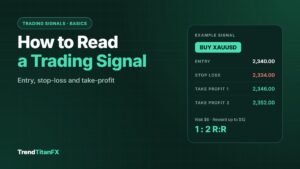
Without a stop loss you cannot calculate your position size or your risk. A signal should always come with an entry, a stop loss and at least one take-profit level.
3. Win rate in context
Win rate is the most advertised and most misunderstood number. Compare these two providers over 10 trades:
| Provider A | Provider B | |
|---|---|---|
| Win rate | 80% | 50% |
| Average win | 10 pips | 60 pips |
| Average loss | 50 pips | 30 pips |
| Result over 10 trades | 8 × 10 − 2 × 50 = −20 pips | 5 × 60 − 5 × 30 = +150 pips |
Provider A wins more often but loses money. Always ask for the average win and loss, or the risk-to-reward ratio, alongside the win rate. You can test any trade’s numbers with the profit/loss calculator.
4. Clear risk guidance
A serious provider tells you how much to risk per trade (often 1–2% or less) and how many trades may be open at once. If they push large lot sizes or “all-in” trades, walk away.
5. Markets you actually want to trade
Gold (XAUUSD) moves very differently from EURUSD or indices. Pick a provider that specialises in your market rather than one that sends a bit of everything.
6. Timing that fits your day
A great signal is useless if it arrives while you are at work. Check when signals are usually sent and whether they suit scalpers, day traders or swing traders. Our guide to forex trading styles can help you decide.
7. Fast, reliable delivery
Telegram is the standard because it is quick. For gold, a delay of even a minute can change the entry price. Some providers also offer a trade copier that places trades for you on MT4/MT5.
8. Transparent pricing
Look for clear prices, what is included in each plan, and how to cancel. Be wary of hidden upsells or plans that are hard to leave.
9. A real company and no regulator warnings
Check who runs the service and search your local regulator’s warning list. In the UK, the FCA has published warnings about unauthorised forex and gold signal services promoted on Telegram and Facebook (IOSCO I-SCAN example). The international I-SCAN database lets you search warnings from many regulators in one place.
10. A free way to test
The best way to judge a provider is to follow their free channel or a trial for a few weeks, ideally on a demo account. If a provider will not let you see any signals before paying, that is a reason to look elsewhere.
Instant red flags
- Guaranteed or “risk-free” profits, a warning sign highlighted by the US CFTC
- Pressure to pay quickly, or “limited spots”
- Asking you to send money to someone who will “trade for you”
- No stop losses, or stop losses that keep moving
- Results shown only as screenshots of winning trades
Quick scorecard
Give a provider one point for each item below. Seven or more is a good sign; four or fewer, keep looking.
- Full dated history, including losses
- SL and TP on every signal
- Average win and loss shared, not just win rate
- Clear risk-per-trade advice
- Specialises in your market
- Signal times suit you
- Fast Telegram delivery or a copier
- Clear prices and cancellation
- Real company, no regulator warnings
- Free channel or trial
Not sure whether to pay at all? Read free vs paid forex signals.
FAQ
What is a good win rate for forex signals?
There is no single good number. A 50% win rate with winners twice the size of losers is profitable, while an 80% win rate with large losses can lose money. Look at win rate and risk-to-reward together.
How can I check if a signal provider is legit?
Ask for a full dated history including losses, check for third-party verification, search regulator warning lists, and test the free channel before paying.
Are Telegram signal groups safe?
Many are genuine, but Telegram is also popular with scammers. Never send money to someone who offers to trade for you, and avoid any group promising guaranteed returns.
How long should I test a provider?
At least a few weeks, so you see both winning and losing periods. A demo account is the safest way to follow along.