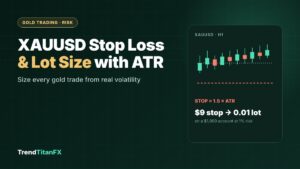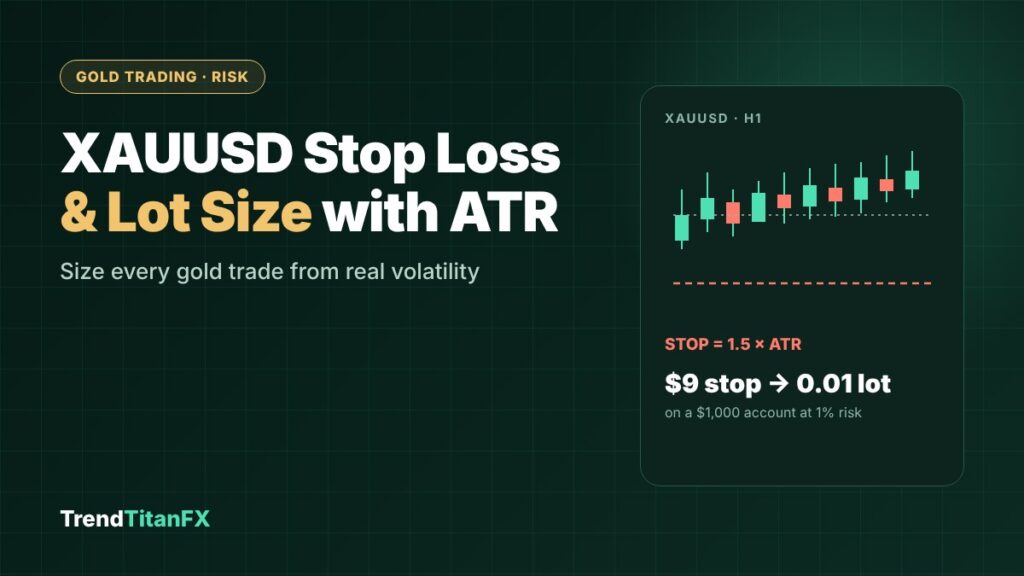
To set an ATR stop loss on XAUUSD, read the Average True Range on the chart you trade, multiply it by 1.5 to 2, and place your stop that far from your entry. Then size the trade from that distance: lot size = risk amount ÷ (stop distance in dollars × 100). On a standard broker, 0.01 lots of gold loses about $1 for every $1 the price moves.
Why fixed stops fail on gold
Many traders use the same stop on every gold trade, for example “always $5”. The problem is that gold’s volatility changes all the time. A $5 stop can be comfortable in a quiet Asian session and far too tight in the hour after a Fed decision or a jobs report, when price can swing that much in a single candle.
An ATR-based stop adjusts automatically: wider when gold is moving fast, tighter when it is calm. Your risk in dollars stays the same because the lot size adjusts with it.
What ATR measures
The Average True Range was created by J. Welles Wilder Jr. in his 1978 book New Concepts in Technical Trading Systems. It measures how far price typically moves per candle, ignoring direction.
For each candle, the true range is the largest of:
- the candle’s high minus its low,
- the gap between the high and the previous close,
- the gap between the low and the previous close.
ATR is the average of these true ranges, most often over 14 candles. On XAUUSD, ATR is shown in dollars, so an ATR of 8.00 on the H1 chart means gold has recently moved about $8 per hour.
Step by step: ATR stop and lot size
- Add the indicator. In MT4/MT5: Insert → Indicators → Oscillators → Average True Range, period 14. In TradingView, search “Average True Range”.
- Use the timeframe you trade. Take the ATR from your entry chart: M5 or M15 for scalps, H1 for day trades, H4 or D1 for swings.
- Pick a multiplier. 1.5× ATR is a common starting point; 2× gives more room in volatile markets. Many traders use somewhere between 1.5 and 3.
- Calculate the stop distance. Stop distance = ATR × multiplier. Place it beyond the nearest swing high or low if that is slightly further.
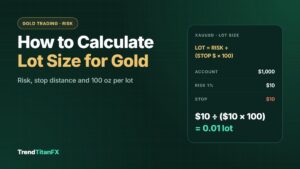
- Size the trade from your risk. Lot size = risk amount ÷ (stop distance × 100). Round down to your broker’s lot step.
Our lot size calculator does step 5 for you: enter your balance, risk %, entry and the ATR-based stop.
Worked example
You plan a buy on the H1 chart. The ATR (14) shows $6.00 and you use a 1.5× multiplier, so your stop is $9.00 below entry. One standard lot (100 oz) would lose $900 over that distance, so 0.01 lots would lose $9.
| Account | Risk at 1% | Exact size | What to trade |
|---|---|---|---|
| $500 | $5 | 0.0055 lots | Below 0.01: skip, or use a smaller timeframe |
| $1,000 | $10 | 0.011 lots | 0.01 lots ($9 risk) |
| $5,000 | $50 | 0.055 lots | 0.05 lots ($45 risk) |
| $10,000 | $100 | 0.111 lots | 0.11 lots ($99 risk) |
ATR value is an example. Read the current ATR on your own chart, as it changes every day.
The small-account problem
The table shows something most guides skip: on gold, the minimum 0.01 lot can already be more than 1% risk on a small account. With a $9 stop, 0.01 lots risks $9, which is 9% of a $100 account and nearly 2% of $500.
If that is you, the options are:
- Trade a lower timeframe, where ATR and therefore the stop are smaller (for example M5 or M15).
- Use a broker that offers smaller lots, such as 0.001 (micro or cent accounts).
- Skip the trade when the stop is too wide for your account. Tightening the stop to make the trade fit defeats the purpose of using ATR.
Using ATR to trail your stop
ATR also works for managing a winning trade. A simple method: once price has moved 1× ATR in your favour, trail the stop to 2× ATR behind the highest high (for a buy) or lowest low (for a sell). The stop only moves in your favour, never back.
Common mistakes
- Using the daily ATR for a scalp. Gold’s daily ATR can be ten times its M5 ATR. Match the ATR to your entry chart.
- Forgetting the spread. Add a small buffer for the spread, especially around news and rollover.
- Keeping the same lot size. The whole point is that wider stops mean smaller lots. Recalculate every trade.
- Entering right before major news. ATR is based on recent candles, so it does not “know” a CPI or Fed release is coming. See the best time to trade gold.
FAQ
What is a good ATR multiplier for gold?
1.5× ATR is a common starting point. Use 2× or more if you are getting stopped out by normal noise, especially on lower timeframes or around news.
Which ATR period should I use?
14 is the standard setting and works well for most traders. A shorter period reacts faster to sudden volatility; a longer one is smoother.
How much does 0.01 lot of gold lose per $1 move?
About $1 on a standard 100-ounce contract. Check your broker’s contract size in the symbol specification, as some differ. Our XAUUSD pip value guide explains this in detail.
Is an ATR stop better than a stop behind a swing level?
They work best together. Use ATR to check that a swing-based stop is not unrealistically tight, and push the stop just beyond the swing level when it is close.