Quick answer: There is no single best gold trading strategy. Most beginners do better with one simple setup: trade in the direction of the trend, enter on a pullback during the London–New York overlap, place the stop-loss beyond a clear level, and size the lot so one loss costs 1–2% of the account.
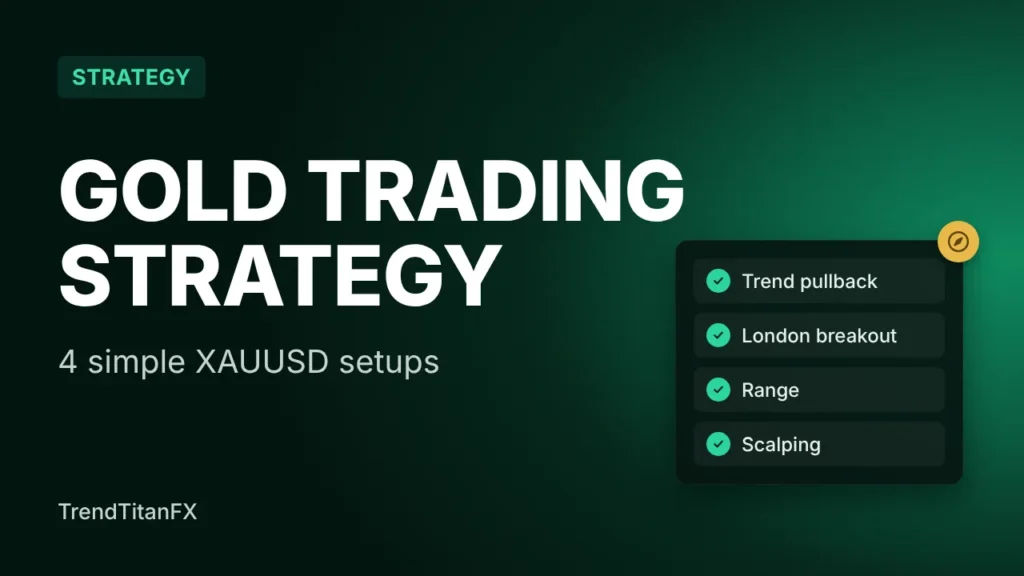
This guide walks through four simple XAUUSD setups: trend pullback, London breakout, range trading and scalping. For each one you get when it works, where to enter, where the stop-loss goes and what usually goes wrong. Then we put the numbers together in one worked example, so you can see how the stop-loss decides the lot size.
How to choose a gold strategy
The right strategy is the one that fits your day and your account, not the one with the most exciting chart. Before you pick a setup, answer three questions.
- How much time do you have? If you can only check charts once or twice a day, a slower setup on the 1-hour or 4-hour chart suits you better than scalping.
- How big is your account? A small account needs small lots and fewer trades, so the setup has to work with a stop you can afford at 0.01 lot.
- What stop size can you afford? Gold often needs a stop of several dollars to survive normal noise. If a sensible stop is too large for 1–2% of your account at 0.01 lot, that setup is not right for you yet.
If you are still learning what a pip or a lot is on gold, start with our gold trading for beginners guide and come back to this page after.
Strategy 1: trend pullback
The trend pullback is the most beginner-friendly gold setup because it trades with the main move instead of against it.
When it works: on days when gold is clearly trending, usually after a steady move in one direction across several sessions.
How to spot the trend: look at the 1-hour and 4-hour charts. An uptrend makes higher highs and higher lows. A downtrend makes lower highs and lower lows. If the two charts disagree, or the swings overlap in a messy way, there is no clear trend and this setup is off for the day.
Entry: wait for price to pull back to a level the market has respected before, such as a previous swing high that turned into support, or a moving average that price has been bouncing from. Enter when price stalls at that level and starts moving back in the trend direction. Do not chase a candle that has already run far from the level.
Stop-loss: beyond the last swing low for a buy, or the last swing high for a sell. If price breaks that swing, the pullback idea is wrong.
Take-profit: twice the stop distance. A $10 stop means a take-profit $20 away. This keeps the reward bigger than the risk without needing a perfect entry.
Main risk: the trend ends just as you enter. That is why the stop goes beyond structure, not at a random dollar amount.
Strategy 2: London breakout
Gold is often quiet during the Asian session and then moves when London opens. The London breakout tries to catch that first move.
Set-up: mark the high and low of the Asian session on a 15-minute or 1-hour chart. That box is your range.
Entry: when London opens (around 8:00 UK time), trade the break. A buy if price closes above the range high, a sell if it closes below the range low. Waiting for a candle close helps you avoid quick spikes that snap straight back.
Stop-loss: inside the range, for example around the middle of the box. If price falls back deep into the range, the breakout has failed.
Take-profit: at least twice the stop distance, or the next clear level, whichever comes first.
When to skip it: on days with big US news such as NFP, CPI or a Fed decision, the London move is often reversed later in the day. Skip those days, and skip days when the Asian range is already very wide. Our guide to the best time to trade gold shows the session hours in your time zone.
Strategy 3: range trading
Gold does not trend all the time. On some days it moves sideways between two clear levels, and range trading uses that.
When it works: only when price is clearly sideways, with at least two touches of the same support and two of the same resistance on the 1-hour chart. If you have to squint to see the range, there is no range.
Entry: buy near support and sell near resistance, after price shows it is turning, such as a rejection candle at the level.
Stop-loss: just outside the range, beyond support for a buy or beyond resistance for a sell.
Take-profit: before the opposite side of the range, not exactly on it. Price often turns a little early.
Exit rule: if a candle closes outside the range, the range is broken. Close any trade that depends on it and do not keep fading the move.
Strategy 4: scalping
Scalping means short trades of a few minutes to an hour, aiming for small moves on the 5-minute chart in the direction of the 1-hour trend. It needs fast decisions, low trading costs and strict discipline, because spreads and overtrading eat small targets quickly. Most beginners find it the hardest of the four. Our full XAUUSD scalping strategy covers the chart setup, entry rules and costs.
Gold strategies compared
Stop sizes below are examples only. Your stop should come from the chart, not from this table.
| Strategy | Chart | Session | Hold | Stop | Risk |
|---|---|---|---|---|---|
| Pullback | H1-H4 | Overlap | Days | $10 (example) | Reversal |
| Breakout | M15-H1 | London | Hours | $7 (example) | Fakeout |
| Range | H1 | Quiet | Hours | $6 (example) | Breaks |
| Scalping | M5 | Overlap | Mins | $4 (example) | Spreads |
Worked example: a trend pullback buy
Example only. This is not a real trade, and no result is shown.
Gold is in an uptrend on the 4-hour chart. Price pulls back to a level that held before, stalls, and starts turning up. You plan a buy at 4,180.00, with the stop-loss below the last swing low at 4,170.00.
- Account and risk: $2,000 account × 1% risk = $20 maximum loss on this trade.
- Stop distance: 4,180.00 − 4,170.00 = $10.00. With 1 pip = $0.10, that is 100 pips.
- Loss per 0.01 lot: 0.01 lot is 1 ounce, so it gains or loses $1 for every $1 move. A $10 stop costs $10 at 0.01 lot.
- Lot size: $20 risk ÷ $10 per 0.01 lot = 0.02 lot. At 0.02 lot, each $1 move is worth $2.
- Take-profit: twice the stop, so $20 away at 4,200.00. That is 200 pips, or $40 at 0.02 lot.
- Reward-to-risk: $40 ÷ $20 = 1:2.
Notice the order: the chart decides the stop, the stop and your risk decide the lot. If the stop had to be $20 instead, the lot would drop to 0.01 for the same $20 risk. Our guide to lot size for gold explains this step by step, and the lot size calculator does the maths for you.
Setting the stop-loss on gold
A stop-loss that is too tight gets hit by normal gold noise. One that is too wide forces a tiny lot. There are two common ways to place it.
- Beyond structure: put the stop past the last swing high or low, or past the level your idea depends on. If price gets there, the setup is wrong, so being out is the right result.
- With ATR: the Average True Range measures how far gold usually moves on your chart. A stop of around 1.5 to 2 times ATR keeps you outside normal noise. Our guide to ATR stop-loss and lot size on XAUUSD shows how to read it and size the trade from it.
Whichever method you use, set the stop before you enter and do not move it further away once the trade is open.
Rules that apply to every strategy
These rules matter more than which setup you choose.
- Keep risk per trade small: 1–2% of the account per trade. These are example limits, so set your own.
- Stop after two losses in a day: close the platform and review the trades tomorrow, when you are calm.
- Skip the minutes around big news: NFP, CPI and Fed decisions can move gold several dollars in seconds, and spreads widen.
- Test on a demo account first: take at least a few weeks of trades with the same rules before you use real money.
- Write it into a plan: your setup, session, risk and daily limits on one page. Our guide to building a forex trading plan gives you a template.
Trading forex and gold involves a high risk of loss. Past results do not guarantee future results.
FAQ
What is the best strategy to trade gold?
There is no single best strategy. The best one for you is a simple setup you can follow every time with small risk per trade. For most beginners, that is a trend pullback during the London–New York overlap.
Which timeframe is best for gold trading?
For beginners, the 1-hour chart for entries and the 4-hour chart for direction work well, because they give clearer levels and fewer false signals than very short charts. Scalpers use the 5-minute chart, but that needs more time and faster decisions.
Can beginners trade gold with a strategy on a small account?
Yes, if you size every trade from the stop-loss and accept that 0.01 lot may be the largest size you can use for a while. Pick setups with stops your account can afford at that size. Our guide to growing a small forex account covers what to expect.
Do gold signals replace a strategy?
No. A signal gives you an entry, stop-loss and take-profit, but you still decide the lot size, how much to risk and when to stop for the day. Use our gold signal provider checklist if you are comparing services.
See these setups in real time.
Join our free Gold channel to watch setups posted with entry, stop-loss and take-profit.