Forcing a trade means entering the market when your rules have not given a setup, usually out of boredom, fear of missing out or the urge to win back a loss. It turns a tested plan into a guess. The fix is a written checklist, a daily trade limit, and treating “no trade” as a valid decision.
What does forcing a trade look like?
Most traders know their setup on paper. Forcing a trade is what happens when the market does not offer it and you trade anyway. Typical signs:
- You enter “because price has been flat for an hour and something must happen soon”.
- You lower your standards: a weak candle “is close enough” to your signal.
- You switch to a smaller time frame to find any reason to enter.
- You take a trade straight after a loss to “get it back”.
- You cannot explain the trade in one sentence using your own rules.
A market example
Here is a typical forced trade on gold (example prices):
- Your plan: buy XAUUSD only after a pullback to the 20 EMA on the 5-minute chart in an uptrend, with a rejection candle.
- At 11:00 UK, gold is drifting sideways between 4,010 and 4,016. No pullback, no signal.
- Bored, you buy at 4,015.80 “because it looks bullish”, with no clear level for your stop.
- Price dips to 4,011. You move your stop lower to avoid being stopped out.
- A US data release at 13:30 pushes gold to 4,002. You close for a $13.80 loss per 0.01 lot, almost four times the $3.50 your normal setup would have risked.
- At 14:10, your real setup appears. You skip it because you are already down for the day, and it would have hit its target.
The forced trade did more than lose money. It broke your risk rule, and it stopped you taking the trade your plan was built for.
Why traders force trades
| Trigger | What you tell yourself | What helps |
|---|---|---|
| Boredom | “I’ve been watching all morning, I should do something.” | Set alerts at your levels and walk away |
| Fear of missing out | “It’s running without me.” | Remind yourself another setup will come |
| Revenge after a loss | “I need to win it back today.” | Stop after 2 losses; review tomorrow |
| Daily profit target | “I need $50 today.” | Set weekly goals; the market owes you nothing daily |
| Overconfidence after wins | “I can’t lose right now.” | Keep the same size and the same rules |
A pre-trade checklist that stops forced trades
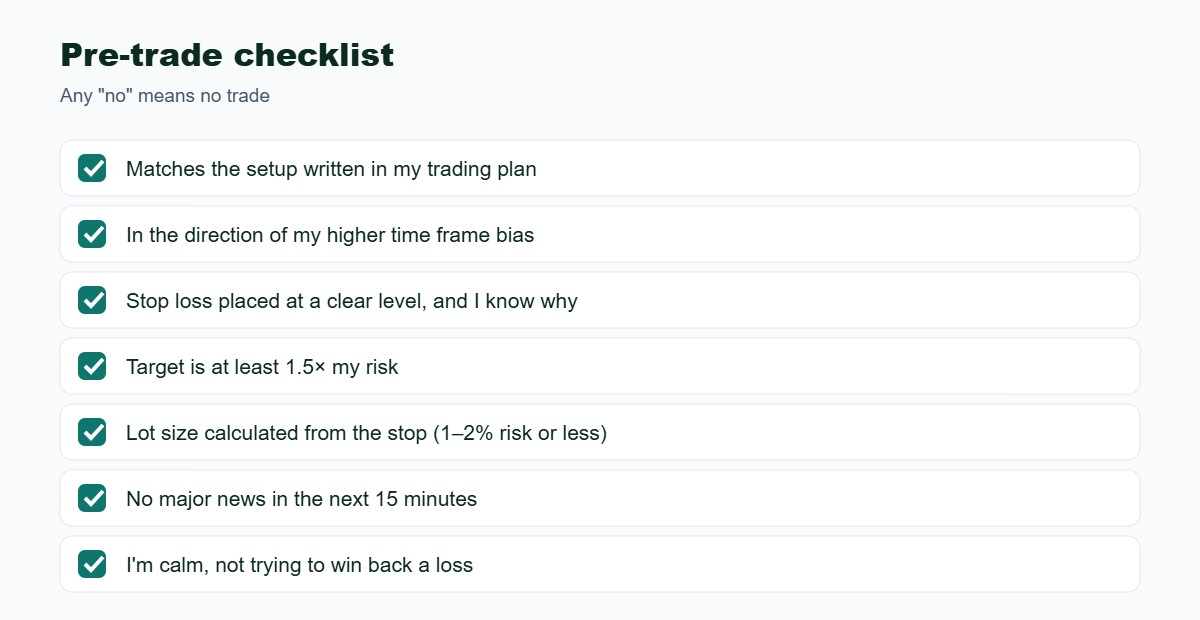
Before every trade, answer these out loud or in your journal. If any answer is “no”, there is no trade.
- Does this match the setup written in my trading plan?
- Is it in the direction of my higher time frame bias?
- Do I know exactly where my stop loss goes, and why?
- Is the target at least 1.5× my risk?
- Is my lot size calculated from the stop, at 1–2% risk or less?
- Is there no major news in the next 15 minutes?
- Am I calm, not trying to recover a loss?
Habits that make “no trade” easier
- Limit trades per day. Two or three quality trades beat ten forced ones.
- Use price alerts instead of watching every candle.
- Journal every trade with a screenshot and a one-line reason. Forced trades are easy to spot when you reread them.
- Trade only your session. If your setup appears in the London–New York overlap, there is no reason to trade at midnight. See the best time to trade gold.
- Follow a structured source. Signals or alerts with a defined entry, stop and target remove the urge to invent trades.
FAQ
Is it ever OK to trade without a setup?
Not if you want consistent results. A trade outside your rules cannot be measured or improved, so even a winning forced trade teaches the wrong lesson.
How do I stop revenge trading?
Set a daily loss limit, for example two losing trades or 2% of the account, and close your platform when you hit it.
What should I do when there are no setups all day?
Nothing. Review your journal, mark levels for tomorrow, or practise on a demo. Not trading is a position.