Quick answer: Gold trading means buying or selling XAUUSD, the price of one ounce of gold in US dollars, to profit from price moves. For beginners, three things matter most: knowing what one pip is worth, trading during the busiest hours, and keeping each loss small with a stop-loss and the right lot size.
Gold is one of the most traded markets in the world, and it moves fast. That speed attracts beginners, and it is also why many of them lose money quickly. This guide explains how gold trading works in plain English, then walks through one of our real signals step by step, so you can see the numbers behind a trade before you risk your own money.
What is XAUUSD?
XAUUSD is the trading symbol for gold priced in US dollars. XAU is the code for one troy ounce of gold, and USD is the US dollar. If XAUUSD shows 4,069.00, one ounce of gold costs $4,069.00.
On trading platforms like MetaTrader 4 and 5, gold is traded in lots:
| Lot size | Ounces of gold | Value at a price of $4,000 |
|---|---|---|
| 1.00 (standard lot) | 100 oz | $400,000 |
| 0.10 (mini lot) | 10 oz | $40,000 |
| 0.01 (micro lot) | 1 oz | $4,000 |
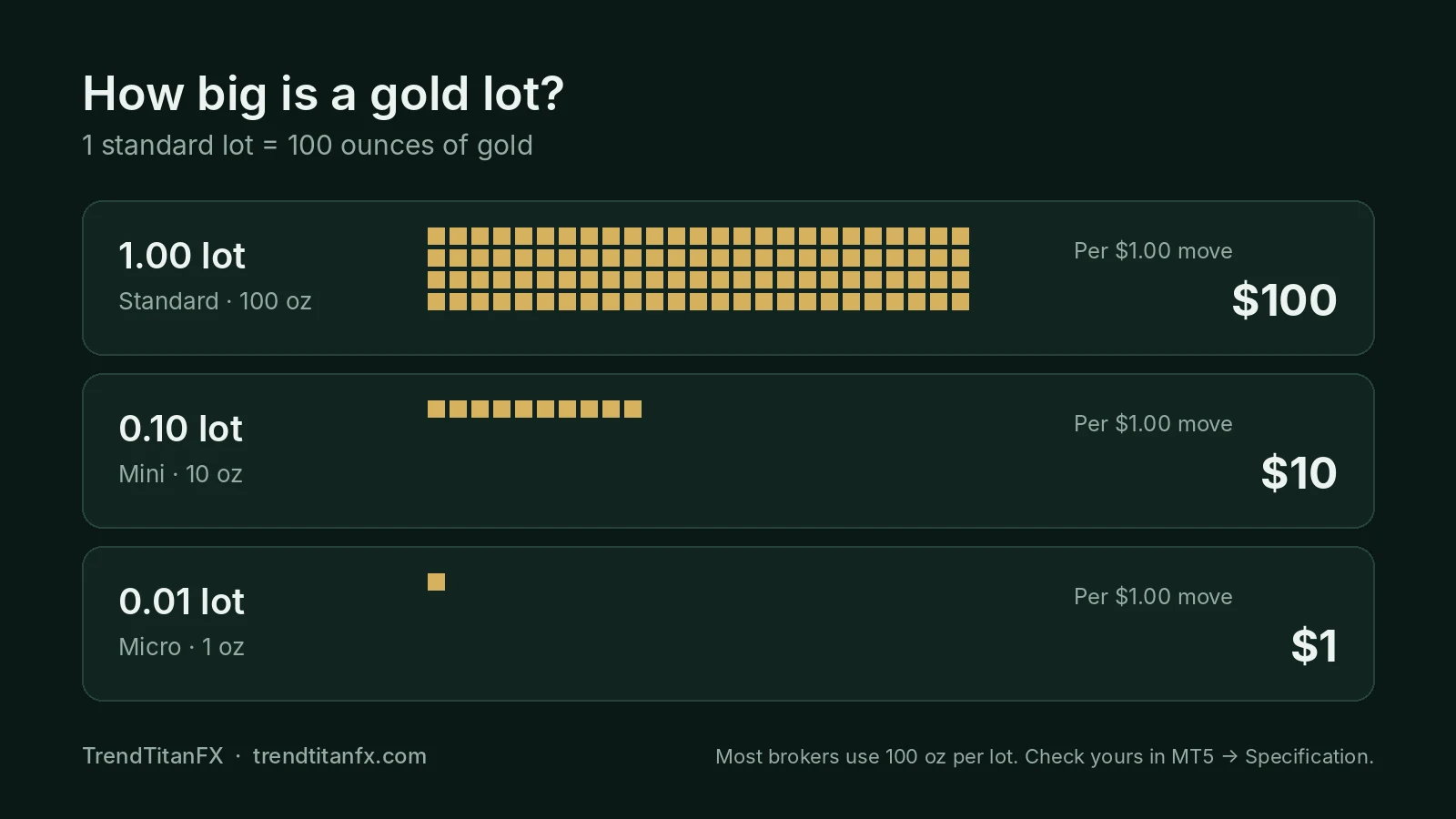
You don’t need $4,000 to open a 0.01 lot trade. Your broker lends you most of it through leverage. Leverage makes small accounts possible, but it also means a small price move can cause a large loss. That is why the rest of this guide is about controlling risk.
Check your own broker once: right-click XAUUSD in Market Watch, then choose Specification. Most brokers use 100 ounces per standard lot.
How gold prices move: pips and points
A pip is how traders count price moves. On gold, brokers don’t agree on what one pip is. Some call a $0.10 move one pip; others call a $0.01 move one pip. TrendTitanFX counts 1 gold pip as a $0.10 price move.
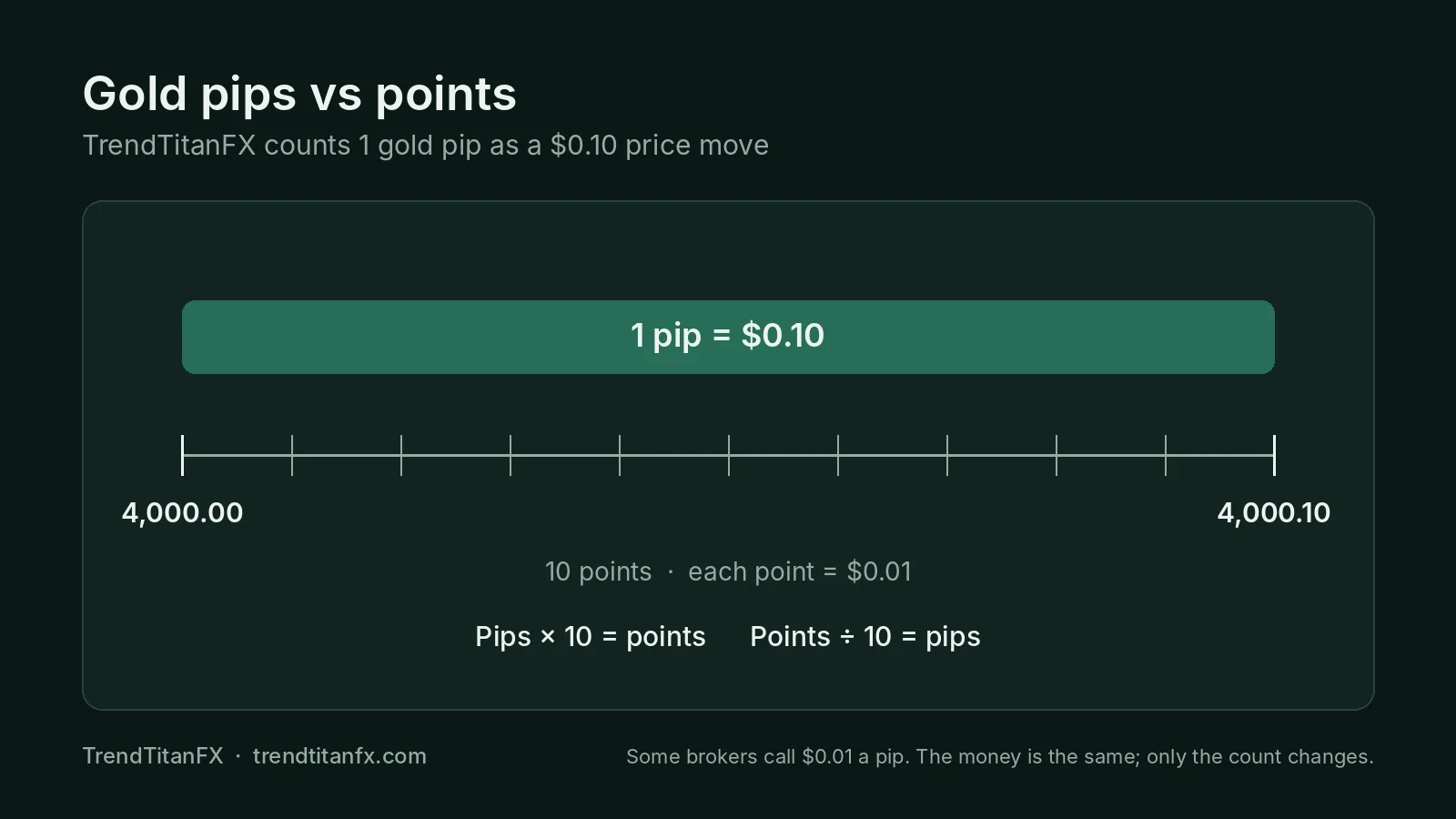
| Price move | Pips ($0.10 pip) | Money on 0.01 lot | Money on 0.10 lot |
|---|---|---|---|
| $0.10 | 1 pip | $0.10 | $1 |
| $1.00 | 10 pips | $1 | $10 |
| $10.00 | 100 pips | $10 | $100 |
| $49.00 | 490 pips | $49 | $490 |
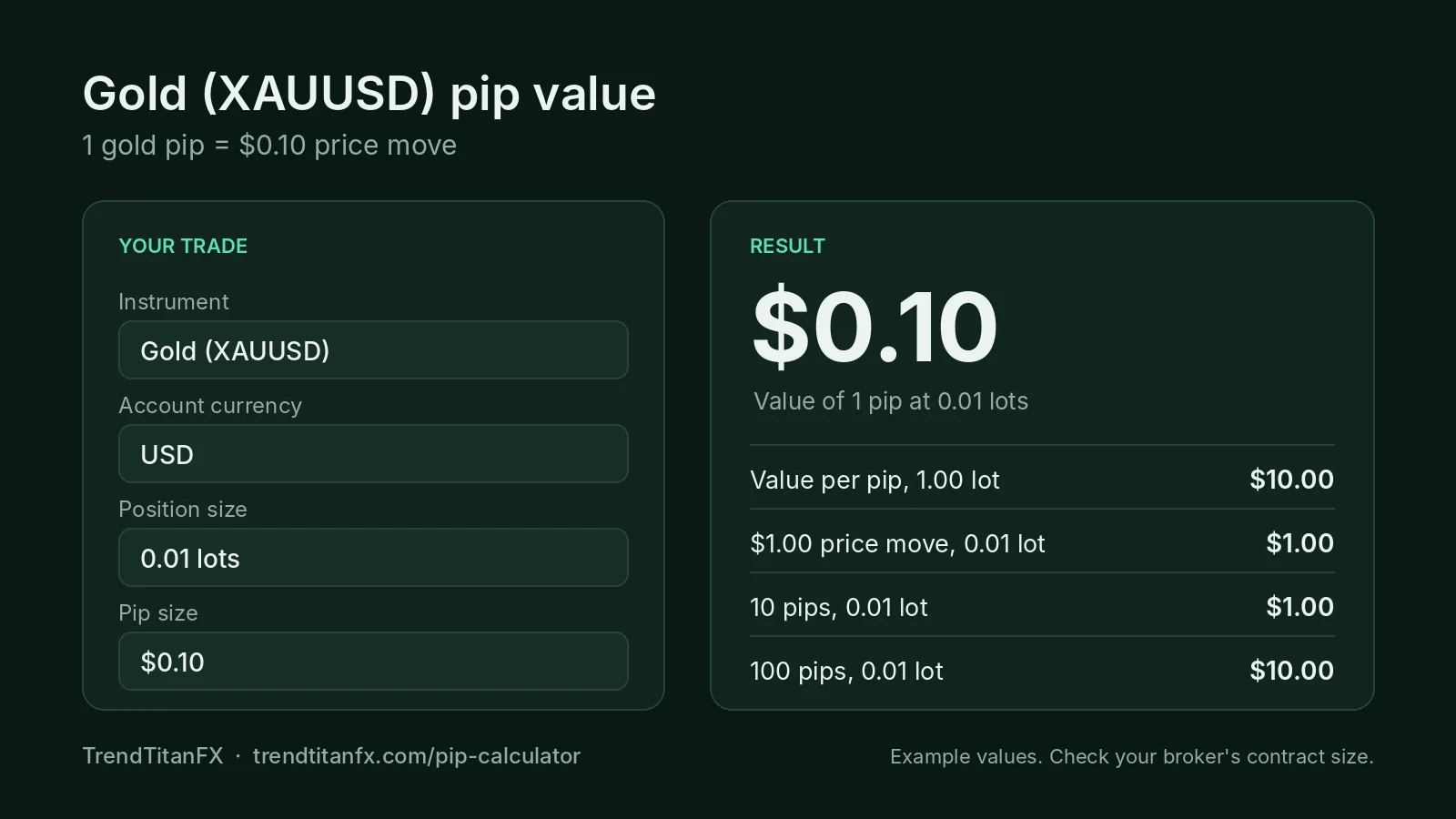
The easy rule: on 0.01 lot, every $1 the gold price moves is $1 of profit or loss for you.
Always check which pip size your broker and your signal provider use. If they differ, a stop-loss can end up ten times closer or wider than you meant. Our guide on how to calculate pips in gold explains this in full, and the pip calculator does the maths for you.
What moves the gold price
Gold reacts most to anything that changes the value of the US dollar or the cost of holding cash. The main drivers are:
- US interest rates. When rates are expected to fall, gold often rises, because cash and bonds pay less.
- The US dollar. Gold is priced in dollars, so a weaker dollar usually means a higher gold price.
- US data. Jobs reports (NFP) and inflation (CPI) change rate expectations, so gold often jumps the minute they come out.
- Fear and uncertainty. Wars, crises and market crashes push some investors into gold as a safe place to hold value.
- Central bank buying. Large purchases by central banks add steady demand over months.
You don’t need to predict these events. You need to know when they happen, so you don’t open a trade one minute before a big release. Read more in what moves the gold price.
When to trade gold
Gold trades almost 24 hours a day, Monday to Friday, but it is not equally active all day. For most beginners, the best window is the London–New York overlap: 8:00 to 11:30 a.m. New York time, which is 13:00 to 16:30 in the UK and 18:30 to 22:00 in India.
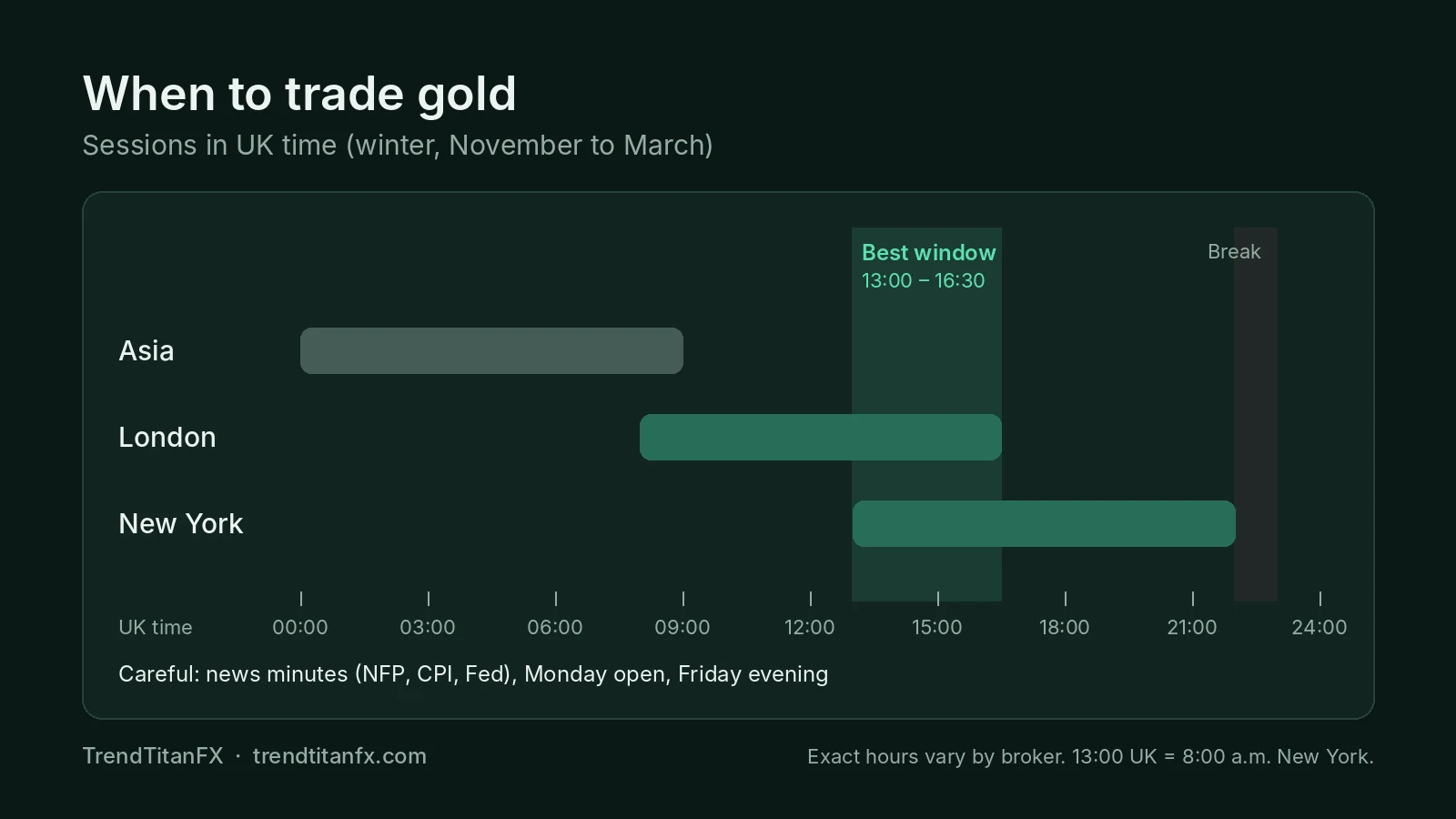
During the overlap, more traders are active, spreads are usually tighter, and big US data releases land. The quietest and riskiest hours are around the daily break at 5:00 p.m. New York time, when spreads often widen.
Three times to be careful:
- The minutes around NFP, CPI and Fed decisions
- Monday open, when price can jump after weekend news
- Friday evening, before the weekend close
See opening and closing times for your time zone in our guide to the best time to trade gold.
How much money you need to trade gold
The honest answer depends on your stop-loss, not on the broker’s minimum deposit. Most brokers let you trade 0.01 lot, the smallest size. On 0.01 lot, every $1 move in gold is $1 for you. So the size of your stop in dollars is also your loss in dollars.
Many traders risk no more than 1% of their account on one trade. Here is what that means on 0.01 lot:
| Stop-loss distance | Loss on 0.01 lot | Account needed at 1% risk |
|---|---|---|
| $5.00 (50 pips) | $5 | $500 |
| $10.00 (100 pips) | $10 | $1,000 |
| $20.00 (200 pips) | $20 | $2,000 |
| $49.00 (490 pips) | $49 | $4,900 |
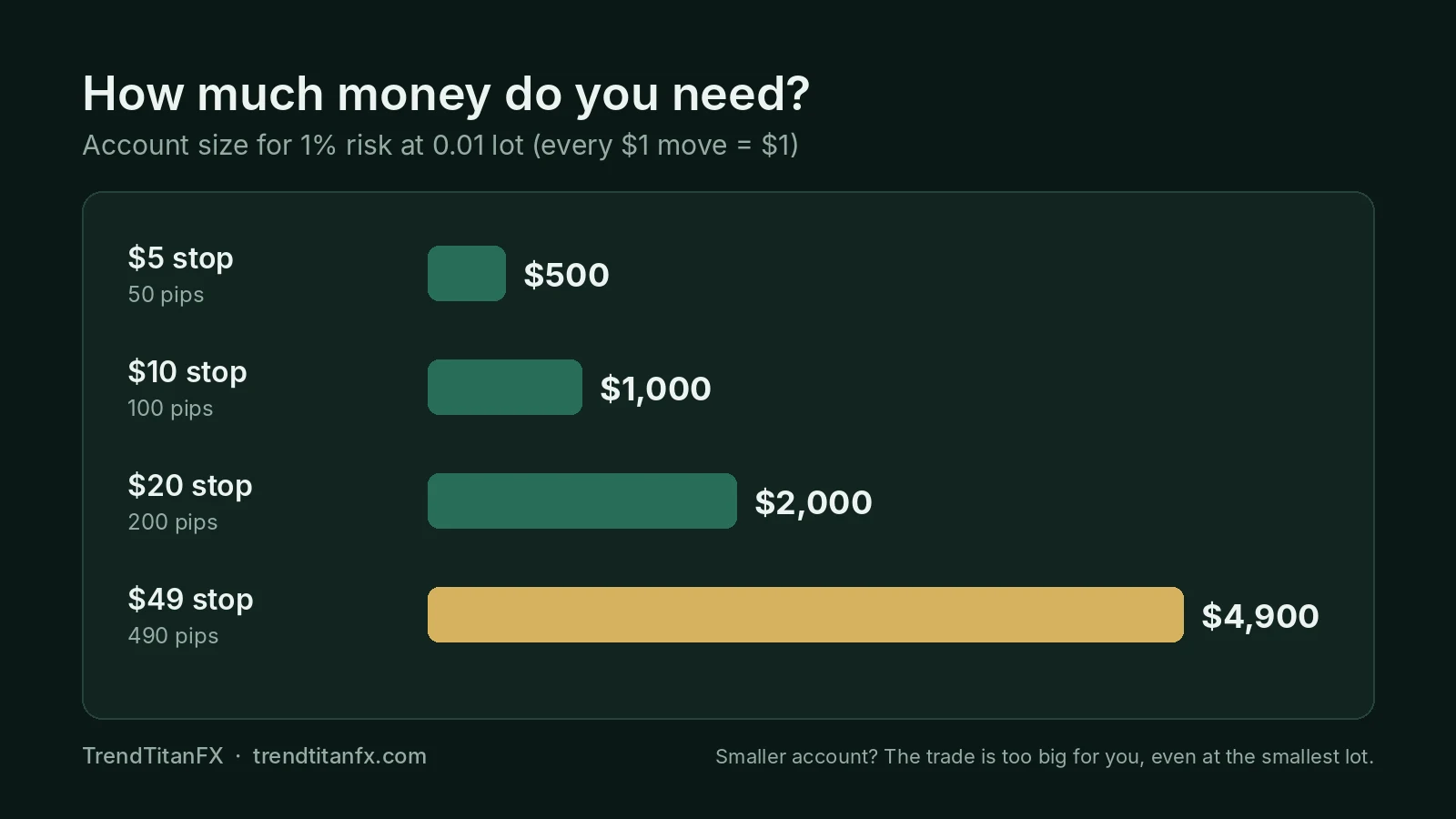
If your account is smaller than the table says, the trade is too big for you even at the smallest lot. Skip it, or wait for a setup with a tighter stop. Our guide on how to calculate lot size for gold and the lot size calculator show how to size any trade.
A real gold signal, step by step
Here is a real signal posted in our free Gold channel on 28 October 2026, exactly as it was sent:
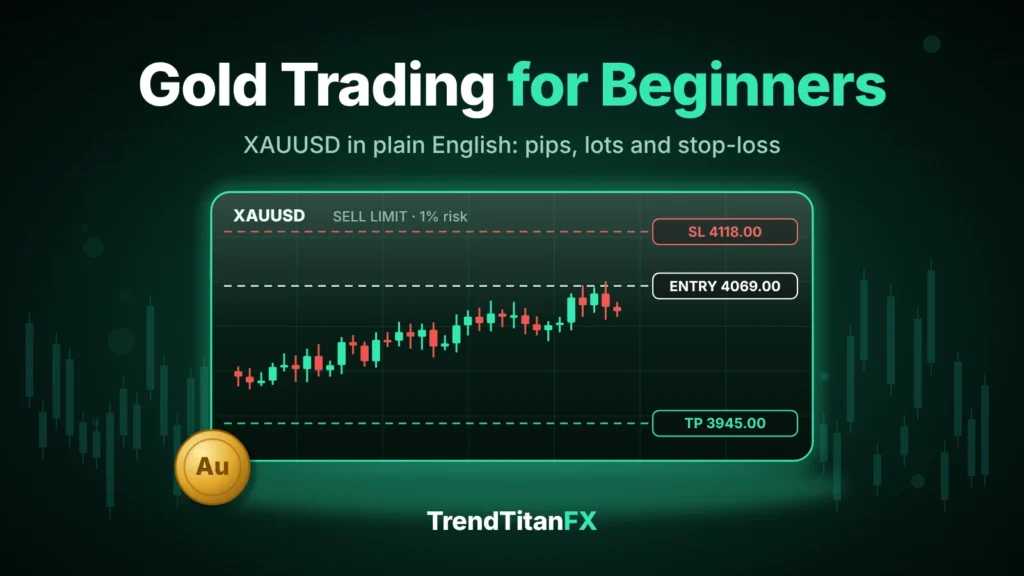
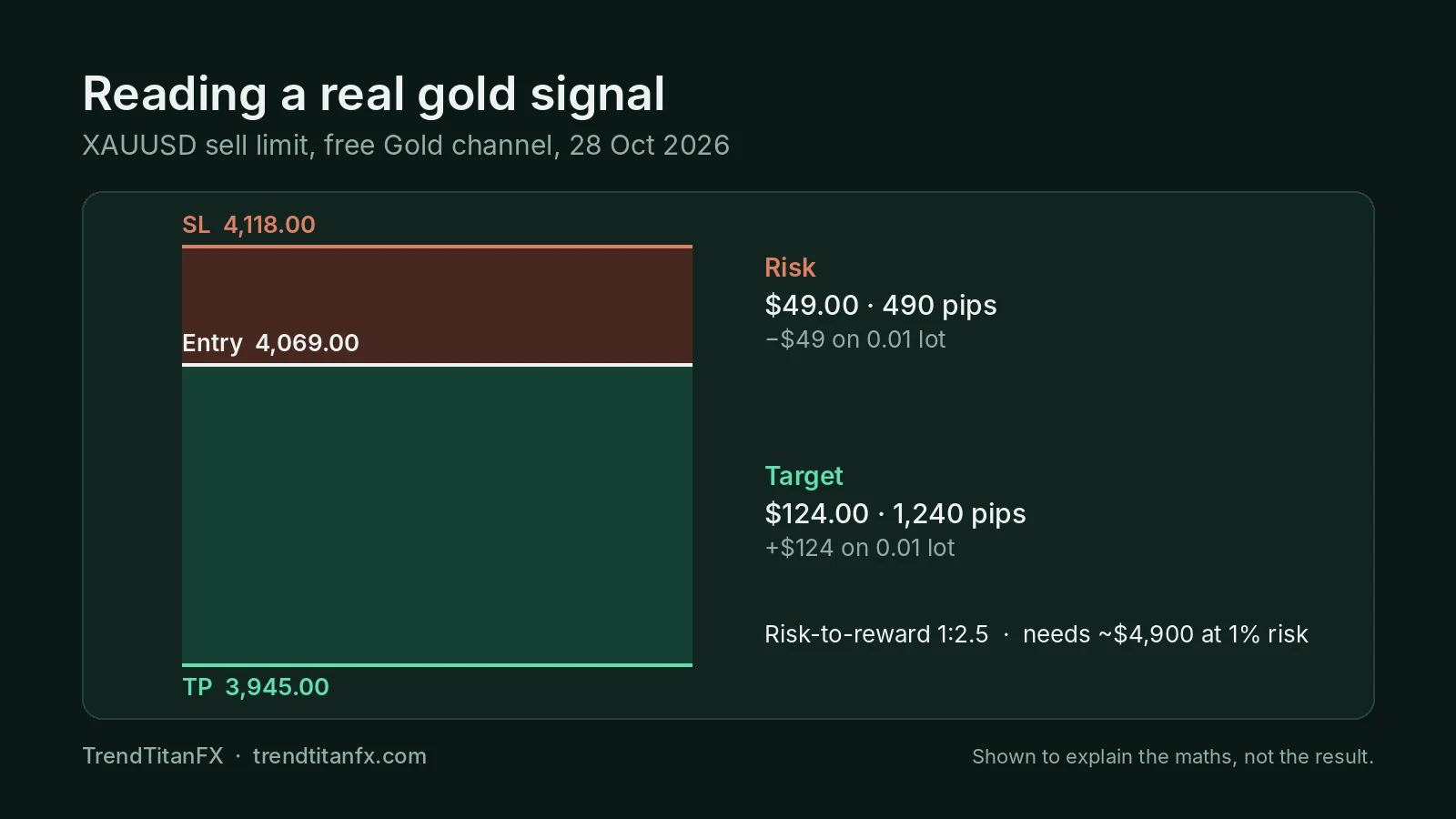
XAUUSD SELL LIMIT · Entry: 4069.00 · SL: 4118.00 · TP: 3945.00 · Risk only 1% per trade
We use it here to show the maths, not the result. Let’s read it the way a careful beginner should.
Step 1: What each part means.
- SELL LIMIT: a pending order to sell, placed above the current price. It only opens if gold rises to the entry price.
- Entry 4069.00: the price where the sell opens.
- SL 4118.00: the stop-loss. If gold rises here, the trade closes at a loss.
- TP 3945.00: the take-profit. If gold falls here, the trade closes at a profit.
Step 2: Measure the distances.
| Distance | Distance in price | Distance in pips ($0.10 pip) |
|---|---|---|
| Entry to stop-loss | 4118.00 − 4069.00 = $49.00 | 490 pips |
| Entry to take-profit | 4069.00 − 3945.00 = $124.00 | 1,240 pips |
Step 3: Turn it into money. On 0.01 lot, $1 of price is $1. So this trade would lose $49 at the stop-loss, or gain $124 at the take-profit.
Step 4: Check the risk-to-reward. $124 ÷ $49 ≈ 2.5. The possible gain is about 2.5 times the possible loss, written as 1:2.5.
Step 5: Can you follow it at 1% risk? The signal says to risk 1% per trade. At 0.01 lot the risk is $49, so you need about $4,900 for $49 to be 1% of your account.
- $5,000 account: 0.01 lot fits (about 1% risk).
- $1,000 account: even 0.01 lot risks about 4.9%. Too big at the 1% rule.
- $100 account: 0.01 lot risks about half the account. Skip this trade.
This is the most important lesson in this guide: the right lot size comes before the entry. A good setup can still be the wrong trade for your account.
Five beginner mistakes with gold
- Trading too big. The platform’s default lot is often 1.00. On gold, a $10 move on 1.00 lot is $1,000. Check the lot size field before every order.
- No stop-loss. Gold can move $20 or more in minutes around US data. Without a stop, one bad hour can empty a small account.
- Mixing up pips and points. If you read “50 pips” as $0.50 when the signal meant $5.00, your stop is ten times too close and gets hit by normal noise.
- Trading the news minute. Spreads often widen sharply around NFP, CPI and Fed decisions, so your real entry can be worse than planned.
- Moving the stop further away. Moving a stop because the trade is losing turns a small, planned loss into a big, unplanned one.
Learning yourself vs following signals
There are two ways to start, and both need the same basics.
| Learning to trade yourself | Following signals | |
|---|---|---|
| What you do | Find your own setups on the chart | Copy setups someone else posts |
| Time needed | Many hours a week | Minutes per signal |
| What you still must do | Size every trade, set every stop | Size every trade, set every stop |
| Main risk | Learning with real money | Trusting a provider you can’t check |
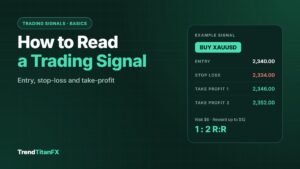
If you follow signals, choose a provider whose signals you can check: posted before entry, with entry, stop-loss and take-profit, and with losing trades shown too. Our 10-point checklist for choosing a signal provider covers what to look for, and how to read a trading signal explains every part of a signal.
Every signal in our channels includes entry, stop-loss and take-profit. You can watch how we post them in our free Gold channel before you decide anything.
FAQ
Is gold good for beginners?
Gold is easy to understand but hard to trade safely, because it moves fast. It can suit beginners who use small lot sizes, always set a stop-loss, and trade during the busiest hours.
Can I trade gold with $100?
Technically yes, at 0.01 lot. But every $1 move is $1 for you, so a $10 stop already risks 10% of a $100 account. Most gold setups need a larger account to stay within 1–2% risk.
How much do I need to start trading gold?
It depends on your stop-loss. At 1% risk on 0.01 lot, you need about 100 times your stop in dollars: a $10 stop needs about $1,000, and a $49 stop needs about $4,900.
What is 1 pip in gold?
TrendTitanFX counts 1 gold pip as a $0.10 price move. On 0.01 lot, one pip is worth $0.10; on 1.00 lot, it is worth $10.
Is gold trading risky?
Yes. Gold is traded with leverage, so losses can be fast and large. Use a stop-loss on every trade, size each trade from your stop, and never trade money you can’t afford to lose.
See how we post gold signals.
Join our free Gold channel to watch real setups with entry, stop-loss and take-profit. 13,800+ members in our free Gold channel.
Trading forex and gold involves a high risk of loss. Past results do not guarantee future results.