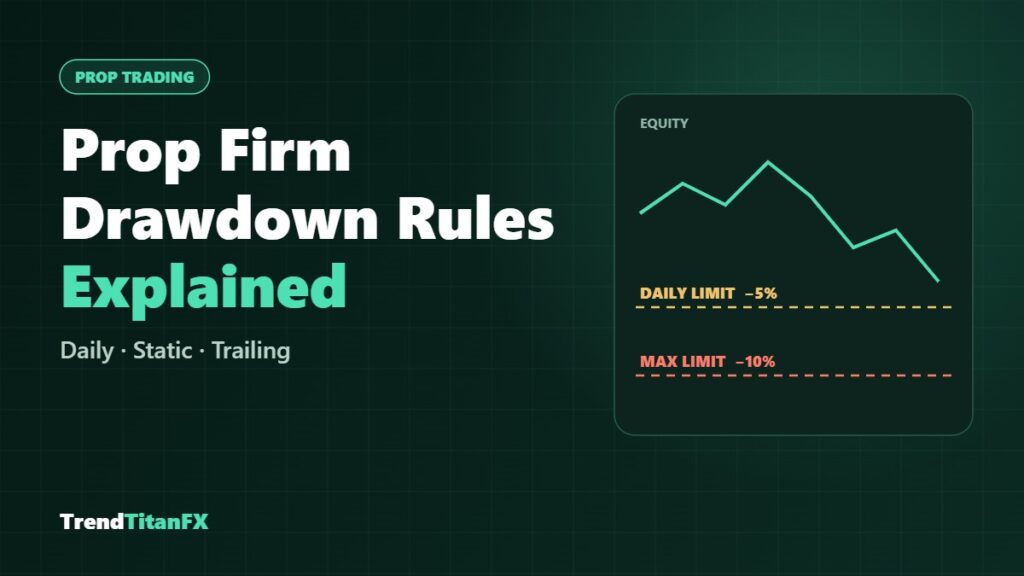
Most prop firms set two loss limits: a daily drawdown (how much you can lose in one day) and a maximum drawdown (how much you can lose in total). The maximum limit can be static (a fixed floor), end-of-day trailing or intraday trailing (a floor that rises as your account grows). Breaking either limit, even for a moment with open trades, usually fails the account. The type of drawdown matters as much as the percentage.
Daily drawdown: your loss limit for one day
The daily drawdown caps how much equity you can lose in a single trading day. A common figure on forex prop challenges is 5%. For example, FTMO’s standard challenge lists a 5% maximum daily loss and a 10% maximum loss.
Two details catch traders out:
New to funded accounts? Read the prop trading challenge guide and how forex signals can help you pass a challenge.
- Where the day starts. Firms measure the daily limit from the day’s starting balance, starting equity or, at some firms, the day’s highest point. The reset time is set by the firm, not your local midnight.
- Open trades count. Most limits are based on equity, so a floating loss can breach the limit before you close anything.
Example: a $100,000 account starts the day at $101,000 with a 5% daily limit based on the starting balance. The daily floor is $96,000 ($101,000 − $5,000). If open trades push equity to $95,900, the account breaches, even if price recovers a minute later.
Maximum drawdown: your total loss limit
The maximum (or overall) drawdown is the lowest your account can ever go. How that floor behaves depends on the type.
| Type | How the floor moves | Difficulty |
|---|---|---|
| Static | Fixed below the starting balance and never moves | Easiest to manage |
| End-of-day trailing | Rises with your closing balance once per day | Medium |
| Intraday trailing | Rises in real time with your highest equity, including open profit | Hardest |
Static drawdown example
On a $100,000 account with a 10% static limit, the floor is $90,000. If you grow the account to $110,000, the floor stays at $90,000, giving you $20,000 of room.
End-of-day trailing example
A $50,000 account with a $2,500 trailing limit starts with a floor of $47,500. You close the day at $51,200, so the new floor becomes $48,700. An intraday high of $53,500 does not matter; only the closing balance moves the floor.
Intraday trailing example
Same $50,000 account and $2,500 trail. A trade briefly shows equity of $51,500, so the floor jumps to $49,000. If the trade then closes for just +$400, your balance is $50,400 but your room has shrunk from $2,500 to $1,400. This is why intraday trailing ends so many accounts (TradeZella).
Many trailing limits stop trailing once you reach a set profit level and then lock, often at the starting balance. Check whether, and when, your firm locks the floor.
Check your buffer before every trade
Before each trade, work out how much room is left between your current equity and the nearest floor. Our free prop firm drawdown calculator does this in seconds: enter your equity and the two floors from your dashboard, and it shows the buffer and which limit is closest.
7 ways to avoid breaching your drawdown
- Risk a small, fixed amount. 0.5–1% per trade means even five losses in a row stay well inside a 5% daily limit.
- Size from your stop loss. Use the lot size calculator so a stop-out costs exactly what you planned.
- Set your own daily stop. Stop trading at, say, 2–3% down, well before the firm’s limit.
- Watch open positions. Several trades on correlated pairs (or gold and silver together) can hit the limit all at once.
- Avoid big news. Fed decisions, CPI and payrolls can gap price past your stop.
- Take profit into trailing limits. On intraday trailing, letting a large open profit turn into a small one tightens your floor for nothing.
- Don’t trade to “fix” a bad day. Revenge trades are how a 2% loss becomes a breach. See forcing a trade without a setup.
FAQ
What is a good drawdown limit for a prop challenge?
Many forex challenges use 5% daily and 10% maximum. A static 10% limit gives far more room than a trailing limit of the same size.
Does floating loss count toward drawdown?
At most firms, yes. Limits are usually measured on equity, which includes open trades. Always check your firm’s rules.
Is end-of-day or intraday trailing better?
End-of-day trailing is easier, because intraday spikes in open profit do not move your floor. Intraday trailing punishes trades that go well and then come back.
Do drawdown rules change between firms?
Yes, often. Percentages, reset times and trailing rules differ and are updated over time, so read your firm’s current rules before you start.