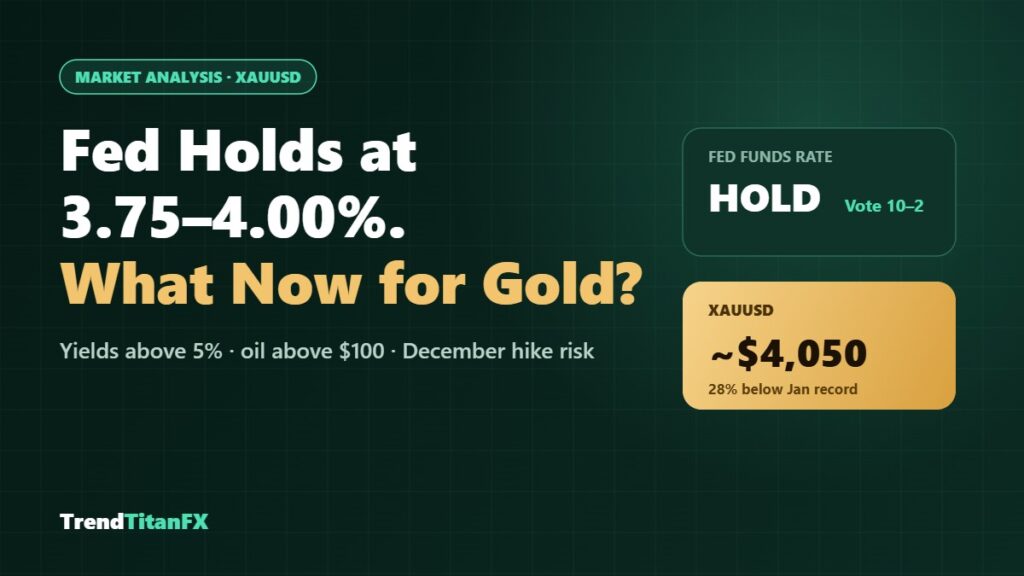
The Fed held rates at 3.75%–4.00% on 28 October 2026, but two officials voted for a hike and markets still price a high chance of a December hike. With 10-year Treasury yields back above 5% and oil above $100, gold (XAUUSD) is stuck near $4,000–$4,050, about 28% below its January record. The next move depends on inflation data and what the Fed signals for 9 December.
What the Fed decided on 28 October
The Federal Open Market Committee left its target range at 3.75% to 4.00%, after raising it by a quarter point in September. The vote was 10–2: Governor Lisa Cook and Cleveland Fed President Beth Hammack both wanted another 0.25% hike (Yahoo Finance).
The statement described growth as expanding at a strong pace and inflation as still elevated, and said more information would help set the next step. In the press conference, Chair Kevin Warsh said the Fed’s moves are “starting to work some”, but that he was “unwilling and unable to call” financial conditions tight. He gave no firm signal for December.
Why gold reacted so little
A hold was widely expected, so the decision itself was already in the price. Spot gold was trading around $4,050 on the day, down about 0.2% (Reuters via Kitco). Three things are holding gold back:
- High real yields. The 10-year Treasury yield moved back above 5% after the decision. Gold pays no interest, so high yields make it less attractive. Our guide on what happens to gold when the Fed raises rates explains this link.
- A possible December hike. Futures priced roughly an 85% chance of a quarter-point hike at the 9 December meeting after the decision (Bloomberg data cited by Yahoo Finance).
- Oil above $100. WTI crude settled at $102.78 on 28 October after an attack on a Saudi refinery. Higher oil feeds inflation fears, which keeps the Fed hawkish. Capital Economics’ Hamad Hussain said the oil rise and the risk of a more hawkish Fed “appears to be weighing on gold prices”.
For context, gold touched about $3,975 on 23 October, its lowest since July, and remains roughly 28% below its January record near $5,590 (Top1 Markets). Analysts polled by Reuters have also cut their 2026 gold forecasts for a second straight quarter.
XAUUSD levels traders are watching
| Level | Price (approx.) | Why it matters |
|---|---|---|
| Resistance 2 | $4,100–$4,150 | Next upside zone if the dollar weakens |
| Resistance 1 | $4,044 / $4,080 | Moving-average area capping rallies |
| Support 1 | $3,975 | Last week’s low, lowest since July |
| Support 2 | $3,900 | A break could open a move toward $3,800 |
Levels as identified by Top1 Markets analysts before the decision. They are reference zones, not trade signals.
Two scenarios for the coming weeks
- Bearish case: inflation data (PCE and GDP, due Thursday 29 October) comes in hot, oil stays above $100 and the market moves to fully price a December hike. A daily close below $3,975 would put $3,900 in focus.
- Bullish case: inflation cools, oil eases and Fed speakers sound less certain about December. The dollar and yields slip, and gold retests $4,080–$4,150. Independent analyst Nikos Tzabouras said a soft PCE and a less hawkish Fed could help bullion “push higher”.
How to trade gold around this kind of news
- Know the calendar. PCE, GDP, the jobs report and Fed speeches can all move gold by tens of dollars in minutes. Check the best times to trade gold and avoid entering seconds before a release.
- Trade the reaction, not the guess. Wait 15–30 minutes after big data for the first spike to settle, then trade in the direction that holds.
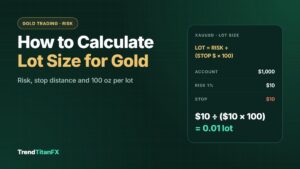
- Use wider stops, smaller size. Volatility is high, so size from your stop with the lot size calculator and check the margin you need before you enter.
- Respect the levels. $3,975 and $4,080 are the nearest lines in the sand. Breakouts that fail back inside the range are common in choppy, news-driven weeks.
FAQ
Did the Fed raise rates in October 2026?
No. It held the federal funds range at 3.75%–4.00% on 28 October, after a 0.25% hike in September. Two of the twelve voters wanted another hike.
Why is gold falling when inflation is high?
Because the Fed is responding to inflation with higher rates, which lifts Treasury yields and the dollar. That raises the cost of holding gold, which pays no interest.
When is the next Fed meeting?
The next decision is on 9 December 2026. Markets were pricing a strong chance of a hike after the October meeting, but that can change quickly with new data.