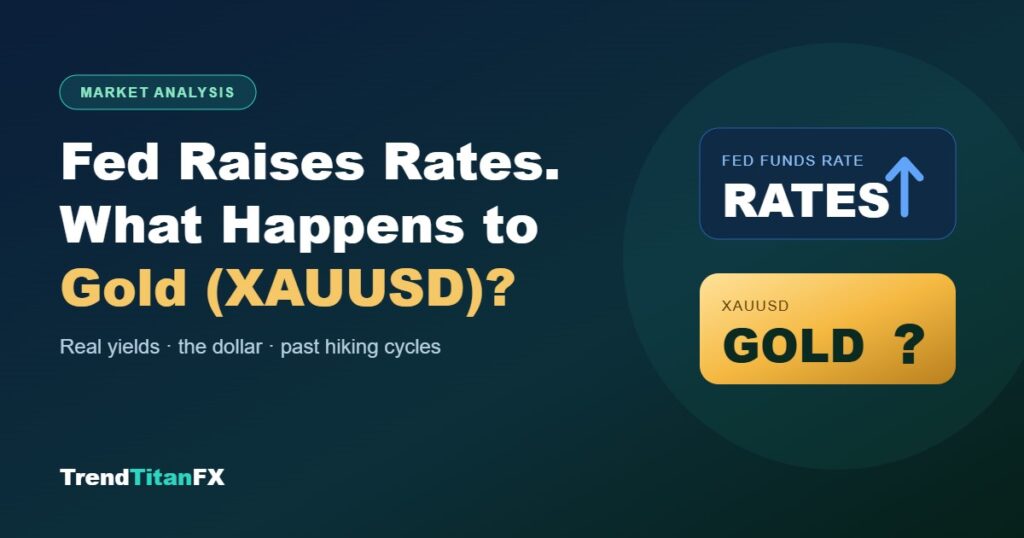
When the Fed raises interest rates, gold (XAUUSD) usually comes under pressure: higher rates make cash and bonds more attractive than a metal that pays no interest, and they tend to lift the US dollar. But it is not automatic. What matters most is real rates (rates minus inflation) and whether the hike was already expected. In 2023–2024 gold rose strongly even with US rates at multi-decade highs.
Why Fed rate hikes usually weigh on gold
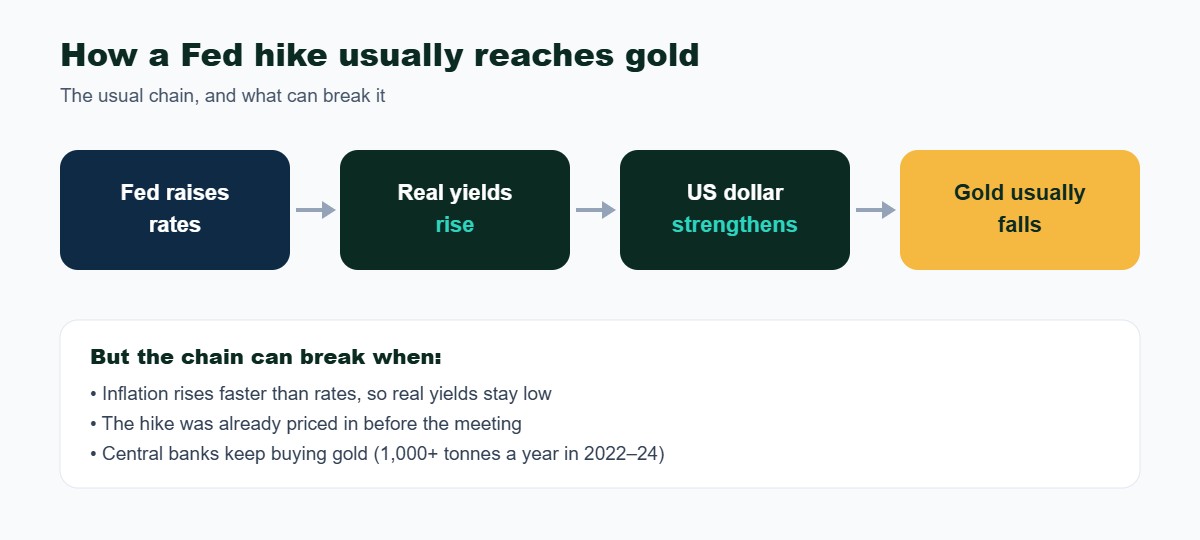
Gold does not pay interest or dividends. That makes the interest rate on cash and government bonds its main competitor. Three forces push in the same direction when the Fed hikes:
- Higher opportunity cost. If a US Treasury pays 4–5% a year, holding gold means giving that up. The higher the rate, the bigger the cost of owning gold.
- A stronger dollar. Higher US rates attract money into dollar assets. Gold is priced in dollars, so a stronger dollar usually means a lower XAUUSD price.
- Higher real yields. If rates rise faster than inflation, the real (inflation-adjusted) return on bonds goes up. Real yields have historically been one of gold’s most important drivers.
Real rates matter more than the headline hike
The headline Fed rate is only half the story. A real rate is the interest rate minus inflation. If rates are 5% but inflation is 6%, the real rate is still negative, and gold can hold up well.
For the most recent reaction, see gold after the Fed hold in October 2026.
Traders watch the 10-year TIPS yield (US inflation-protected bonds) as the market’s live measure of real rates. You can find it free on the St. Louis Fed’s FRED site under the code DFII10. As a rule of thumb: a rising TIPS yield is a headwind for gold; a falling one is a tailwind.
What happened in past hiking cycles
History shows gold does not always fall when the Fed hikes. According to Money Metals’ review of five hiking cycles:
| Hiking cycle | Gold start → end | Change |
|---|---|---|
| 1977–1980 | $132 → $675 | +411% |
| 1980–1982 (Volcker) | $675 → $315 | −53% |
| 2004–2006 | $392 → $596 | +52% |
| 2015–2018 | $1,076 → $1,250 | +16% |
| 2022–2023 | $1,948 → $1,951 | +0.2% |
The big loser was 1980–82, when Paul Volcker pushed real rates sharply and lastingly positive. In the other cycles, inflation was high or rising, so real rates stayed low and gold held up.
The start-to-end numbers also hide big swings in between. During the 2022 cycle, gold fell from roughly $2,070 to roughly $1,618, a drop of about 22%, before recovering (GoldSilver). For a trader, those swings matter far more than where the cycle ended.
Why gold rose in 2023–2024 despite high rates
After 2022, the old link between gold and real yields weakened. RBC Wealth Management notes that central banks bought more than 1,000 tonnes of gold in each of 2022, 2023 and 2024, about double their 2010–2021 average. That steady buying helped gold rise even while US real yields stayed near 2%.
The lesson: Fed policy is a major driver of gold, but not the only one. Central bank demand, geopolitics and the dollar can outweigh it for long periods.
“Buy the rumour, sell the fact”: expected vs surprise hikes
Markets price in Fed moves before they happen. By the day of a meeting, a widely expected 0.25% hike is usually already reflected in the gold price. What moves XAUUSD on the day is the surprise:
- Hawkish surprise (bigger hike than expected, or signals of more hikes): gold usually drops.
- Dovish surprise (smaller hike, a pause, or hints of cuts): gold often rallies, sometimes even on a hike day.
- The press conference 30 minutes after the decision often matters as much as the decision itself.
How to trade XAUUSD around a Fed decision
- Know the time. Fed decisions are released at 2:00 p.m. New York time, usually 19:00 UK. See our guide to the best time to trade gold for other key releases.
- Check what is priced in. Look at market expectations (for example the CME FedWatch tool) before the meeting.
- Reduce size or stay flat into the release. Spreads widen and price can spike both ways within seconds.
- Trade the reaction, not the guess. Many traders wait 15–30 minutes after the press conference starts and trade the direction that holds.
- Size from your stop. Gold can move tens of dollars within minutes on a Fed day, so a normal lot size can mean an outsized loss. Use our XAUUSD pip value guide and lot size calculator.
FAQ
Does gold always go down when interest rates go up?
No. Gold rose during most Fed hiking cycles since the 1970s. It tends to fall when real rates rise sharply and unexpectedly, as in 1980–82 and during 2022.
What happens to gold when the Fed cuts rates?
Cuts usually support gold, because they lower the opportunity cost of holding it and tend to weaken the dollar. Again, the reaction depends on how much was already expected.
Why does the US dollar matter for XAUUSD?
XAUUSD is gold priced in US dollars. If the dollar strengthens, it takes fewer dollars to buy an ounce of gold, so the quoted price tends to fall.
What is the best indicator to watch?
The 10-year TIPS (real) yield and the US dollar index give the clearest picture of the rate pressure on gold.