Connor Jackson | Updated April 2026 | 6 min read
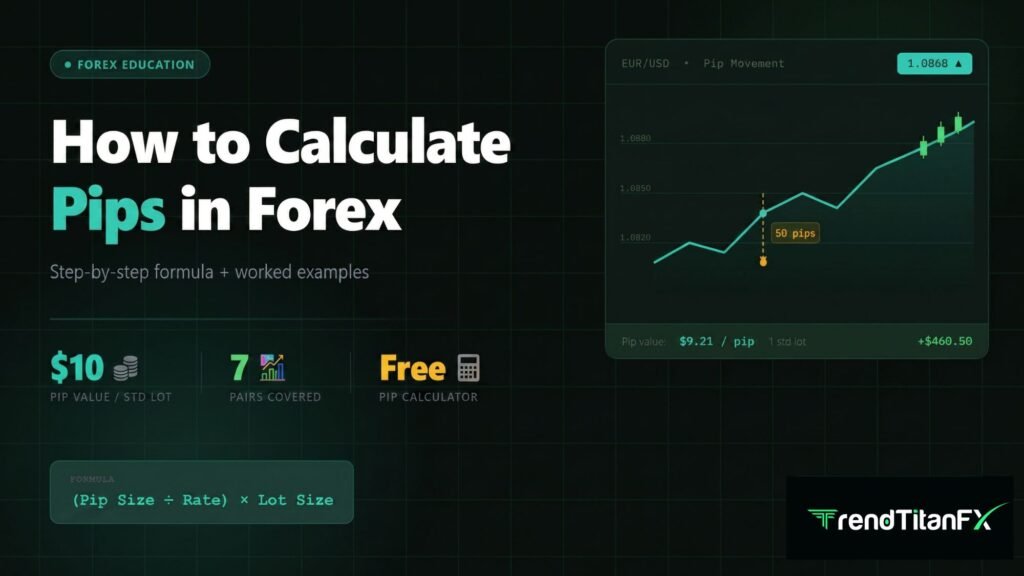
A pip (percentage in point) is the smallest standard price movement in forex. For most pairs it equals 0.0001. To calculate pip value: multiply the pip size by your lot size, then divide by the current exchange rate. Use a pip calculator to get instant results without manual maths.
How to calculate pips in forex is one of the first skills every trader needs to master. Get it wrong and you have no idea how much you are actually risking on each trade — or how much you stand to gain.
This guide breaks down the pip calculation formula step by step, covers major pairs and instruments, and includes worked examples you can follow right now. If you want to skip the manual maths, our free forex pip calculator does all of this instantly.
According to BabyPips, understanding pip values is foundational to every forex risk management strategy — and it is one of the most common gaps in a beginner’s education.
In This Guide
What Is a Pip in Forex?
A pip stands for “percentage in point” — it is the smallest standardised unit of price movement in the forex market. For most currency pairs, one pip equals 0.0001 (the fourth decimal place). For Japanese yen pairs, one pip equals 0.01 (the second decimal place).
If EUR/USD moves from 1.0850 to 1.0851, that is a one-pip move. If it moves from 1.0850 to 1.0950, that is 100 pips. As Investopedia explains, the pip is the basic unit traders use to express gains and losses in any currency pair.
A pip = 0.0001 for most pairs (EUR/USD, GBP/USD, etc.). A pip = 0.01 for JPY pairs (USD/JPY, GBP/JPY, etc.). Some brokers quote a fifth decimal place — this smaller unit is called a pipette (0.1 of a pip).
Why Does Pip Calculation Matter?
Every time you enter a trade, your profit or loss is measured in pips. To know your actual risk in pounds or dollars, you need to convert those pips into a monetary value. That is what the pip calculation formula does.
Without knowing your pip value, you cannot set a correct stop loss, size your position accurately, or apply the 1% rule for account protection — all of which are fundamental to staying in the game long-term.
How to Calculate Pips in Forex: The Formula
The formula for how to calculate pips in forex is straightforward once you understand the three variables involved:
Where:
- Pip Size = 0.0001 for most pairs, 0.01 for JPY pairs
- Exchange Rate = the current price of the pair
- Lot Size = number of units in your trade (standard lot = 100,000 units)
For USD-quoted pairs like EUR/USD or GBP/USD, pip value is always approximately $10 per standard lot because the quote currency is already USD.
Step-by-Step Pip Value Examples
Below are three worked examples showing how to calculate pips in forex across the most common instruments traded by our signal members.
Example 1: EUR/USD (Standard Lot)
This is the most common calculation new traders need.
Pip size for EUR/USD = 0.0001
Lot size = 100,000 units (1 standard lot)
Current rate = 1.0850
Pip Value = (0.0001 ÷ 1.0850) × 100,000 = $9.22 per pip
Because EUR/USD is a dollar-quoted pair, pip value shifts slightly with the exchange rate. Most traders round to $10 per pip per standard lot for quick mental maths.
Example 2: USD/JPY (JPY Pair)
JPY pairs use a pip size of 0.01 instead of 0.0001.
Pip size for USD/JPY = 0.01
Lot size = 100,000 units (1 standard lot)
Current rate = 151.50
Pip Value = (0.01 ÷ 151.50) × 100,000 = $6.60 per pip
JPY pairs have a lower pip value because of the larger exchange rate number. Worth knowing when you switch between standard G10 pairs and yen crosses.
Example 3: XAU/USD (Gold)
Gold (XAU/USD) uses a pip size of 0.01 and a lot size of 100 ounces.
A 10-pip move in gold on a 1-lot trade = $10. A 100-pip move = $100. Use our gold pip calculator to check exact values before every trade.
Pip Values at a Glance — Major Pairs and Instruments
Use this table as a quick reference before entering a trade:
| Currency Pair | Pip Size | 1 Lot = X Units | Pip Value (USD) |
|---|---|---|---|
| EUR/USD | 0.0001 | 100,000 EUR | ~$10.00 |
| GBP/USD | 0.0001 | 100,000 GBP | ~$10.00 |
| USD/JPY | 0.01 | 100,000 USD | ~$6.60 |
| EUR/JPY | 0.01 | 100,000 EUR | ~$6.60 |
| XAU/USD (Gold) | 0.01 | 100 oz | $1.00 |
| NAS100 | 0.01 | 1 contract | $1.00 |
| US30 (Dow) | 1.0 | 1 contract | $1.00 |
Note: JPY pair pip values fluctuate more than dollar-quoted pairs. Always recalculate or use a real-time pip value calculator for accurate figures, especially during volatile sessions.
Pip Values Across Different Lot Sizes
Most new traders start with mini or micro lots. Here is how pip value scales with your position size:
| Lot Type | Units | Pip Value (EUR/USD) | Good For |
|---|---|---|---|
| Standard | 100,000 | ~$10 | Funded / prop accounts |
| Mini | 10,000 | ~$1 | Intermediate traders |
| Micro | 1,000 | ~$0.10 | Beginners, low-risk practice |
Starting with micro lots lets you practice with real money while keeping maximum risk per trade under $1 on a 10-pip stop. Once consistently profitable at micro level, step up to mini lots.
Using a Pip Calculator vs Manual Calculation
Now that you know how to calculate pips in forex manually, the next step is speed. Doing this by hand before every trade is slow — and mistakes cost money.
Our free forex pip calculator lets you:
- Select any currency pair or instrument (including Gold, NAS100, US30)
- Enter your lot size and account currency
- Get the exact pip value in your account currency instantly
Use the pip calculator before setting your stop loss. If your stop is 30 pips away and you want to risk $30, divide $30 by the pip value. If pip value is $1, you need 0.1 lot. This keeps your position on the 1% rule automatically.
Every TrendTitanFX signal includes the exact entry, stop loss, and take profit levels — your pip risk is calculated before you open the chart. Join over 500 active traders receiving daily signals direct to Telegram.
Frequently Asked Questions
What is a pip in forex trading?
A pip is the smallest standardised price movement in forex. For most currency pairs one pip equals 0.0001. For Japanese yen pairs it equals 0.01. Pips measure price movements and are used to calculate profit, loss, and risk on every trade.
How do I calculate pip value in forex?
To calculate pip value in forex, divide the pip size by the current exchange rate, then multiply by your lot size. For EUR/USD at 1.0850 with 1 standard lot: (0.0001 ÷ 1.0850) × 100,000 = $9.22 per pip. For USD-quoted pairs this is approximately $10 per pip per standard lot.
What is the pip value for gold (XAU/USD)?
Gold pip value = (0.01 ÷ 1) × 100 = $1 per pip per standard lot. A 50-pip move in gold on a 1-lot trade equals $50 profit or loss. Use the gold pip calculator for real-time values at any lot size.
How many pips is a good profit in forex?
Focus on risk-reward ratio rather than pip count. What matters is pip value multiplied by lot size. Most experienced traders target at least 1:2 — risking 30 pips to make 60 pips. A 10-pip gain at $10 per pip on 1 standard lot = $100.
What is the difference between a pip and a pipette?
A pipette is one-tenth of a pip, shown at the fifth decimal place (e.g. EUR/USD at 1.08503). Pipettes give more precise entry and exit levels, but most traders and signal providers quote levels in full pips for simplicity.
Do pip values change over time?
Yes — pip values shift as exchange rates move. Recalculate before each session using a real-time pip calculator, particularly for JPY pairs and gold during major news events.
How to Calculate Pips in Forex: Final Word
Every successful forex trade starts with knowing your numbers. Knowing how to calculate pips in forex is not optional — it is the foundation of risk management, position sizing, and consistent trading performance.
The formula is simple: (Pip Size ÷ Exchange Rate) × Lot Size. Run this or use the free pip calculator before entering any position. Pair accurate pip calculation with reliable signals and you have the two ingredients every trader needs.
Join our Forex VIP signal service and receive professional signals direct to your Telegram — with entry, stop loss, and take profit already calculated for you.