(ESMA, 2025)
(BIS, 2025)
Most forex traders don’t have a trading plan. They have a rough idea.
“I’ll buy when it looks bullish.” “I’ll sell when the trend breaks.” “I’ll stop when I’ve lost too much.”
That’s not a plan. That’s improvisation — and improvisation in forex is a slow way to empty your account.
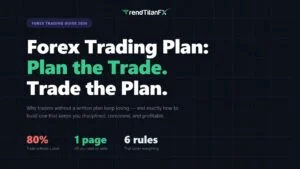
According to ESMA data published in 2025, between 74% and 89% of retail CFD and forex accounts lose money. The FCA puts the UK figure at 70–80%. The single most cited reason across all regulatory bodies and broker disclosures: no defined rules for entry, exit, or position sizing. In other words — no plan.
The traders who stay profitable over time share one habit above all others. They plan the trade before they enter it, and they trade the plan once they’re in it. No adjustments mid-trade. No decisions made under pressure with money on the line.
This guide shows you how to build a simple, one-page forex trading plan from scratch — one you’ll actually use, not one that lives in a Google Doc you open once and forget.
| 📋 What you’ll learn→ What a forex trading plan actually is — in one sentence → Why most traders skip it and pay for it later → The 6 elements every plan needs (nothing more required) → How to apply your plan using structured signals as setups |
What a Forex Trading Plan Actually Is
A forex trading plan is a written set of personal rules that answers three questions before every single trade: what am I trading and why, when do I enter and exit, and how much am I risking. That’s it. It doesn’t need to be ten pages. The best trading plans fit on one page. What matters is that the answers are written down, specific, and followed without exception.
What a trading plan is not: a prediction. It doesn’t tell you the market will go up or down. It tells you what you will do in either scenario — so you’re never making decisions under the emotional pressure of an open position moving against you.
| ⚠️ WarningIf you’re making trading decisions while a position is already open and moving against you — you don’t have a plan. You have a reaction. Those are the trades that turn small drawdowns into account wipes. |
Why Most Traders Skip It — And Pay for It Later
Here’s the honest reason most traders don’t have a written plan: writing one forces you to confront the gaps in your strategy. When you sit down to write “my entry criteria are…” and you can’t finish the sentence with something specific — that’s uncomfortable. It’s easier to just trade and figure it out as you go.
The problem is the market doesn’t give you time to figure it out. A setup forms in 30 seconds. If you don’t already know your rules, you’re deciding on the fly — and decisions made under real-time financial pressure are almost always worse than decisions made calmly in advance.
After 5+ years of live trading — including passing prop firm evaluations where every rule violation is permanent — I can tell you the traders who fail are rarely failing because of bad strategy. They’re failing because they have no defined framework for when to trade and when to stay out.
The 6 Elements of a Good Forex Trading Plan
1. Your Trading Style and Time Commitment
Be honest about how much time you actually have before choosing anything else. This is the most skipped step and the most important one.
A full-time trader watching screens all day can scalp or day trade. A part-time trader with a job, family, or other commitments should be swing trading — taking positions that play out over hours or days, not minutes. According to data published by GoatFundedTrader in 2026, full-time traders outperform part-time traders by approximately 35% — not because they’re smarter, but because they match their style to their available time.
Trading a style that doesn’t match your schedule is one of the most common reasons retail traders fail. You pick scalping because it looks exciting on YouTube, then miss your entries because you’re at work.
| 💡 PRO TIP Write this down before anything else: “I have X hours per day available to trade, during the [London/New York/both] session(s).” If you have less than 1 hour per day — swing trading is your style. Full stop. If you’re a part-time trader, the Swing VIP channel is built exactly for your schedule. |
2. The Markets and Pairs You Trade
Pick 2–3 currency pairs and learn them properly. That’s it. Every instrument has its own personality — its own typical daily range, its own reaction to news, its own session behaviour. XAUUSD behaves completely differently to EURUSD. Trading both without understanding both is guesswork.
- EURUSD — tight spreads, clean structure, ideal for learning
- XAUUSD (Gold) — higher volatility, wider ranges, strong trend moves
- GBPUSD — sharper moves, reacts strongly to UK economic data
Write this down: I trade [pair 1] and [pair 2] only. No other instruments until I have 30 days of documented results on my chosen pair.
3. Your Entry Rules — Specific, Not Vague
Entry rules must be specific enough that two different traders reading them would take the same trade. “I buy when there’s a bullish setup” is not a rule. “I buy on a bullish engulfing candle at a key support level during the London session, confirmed by a higher low on the 1H chart” is a rule.
For every entry, define these four things before you trade:
- What timeframe am I looking at?
- What pattern or signal triggers my entry?
- What confirms it? (second condition)
- What invalidates it? (the condition that means I don’t trade)
If you can’t answer all four before the trade — you don’t have an entry rule. You have a hunch.
4. Your Exit Rules — Both Directions
The exit determines your actual result, yet most traders spend all their energy on entries and barely think about exits. You need two exit rules defined before you enter — one for when the trade goes right, one for when it goes wrong.
For every trade, answer these before clicking buy or sell:
- Where is my stop loss? (specific price level — not “I’ll see how it goes”)
- Where is my take profit? (at least one level defined before entry)
- What is my risk-reward ratio? (minimum 1:2 recommended)
Use the TrendTitanFX Profit/Loss Calculator to calculate the actual dollar value of your setup before entering. Knowing a trade risks £120 and targets £240 is more motivating — and more disciplined — than thinking in abstract pips.
| 💡 PRO TIP Write your stop loss and take profit into your plan before the trade opens. Then don’t touch them. The version of you who set those levels was calmer and more objective than the version of you watching price tick against your position in real time. |
5. Your Risk Management Rules
Risk management is the section that decides whether you still have a trading account in six months. Three rules cover the essentials:
| Rule | What It Means | Why It Matters |
|---|---|---|
| Risk per trade | Maximum 1–2% of account per trade | Absorb 10 consecutive losses and survive |
| Daily loss limit | 3–5% of account — stop and close platform | Prevents one bad day from becoming catastrophic |
| Max drawdown | If down 10–15% from peak, stop and review | Forces you to fix the problem before it compounds |
Use the TrendTitanFX Lot Calculator to size every position correctly before entry. This is not optional — position sizing decides more trading outcomes than entry quality does.
6. Your Weekly Review Routine
A trading plan without a review routine is a plan that slowly becomes outdated and ignored. Once a week — 20 minutes is enough — review your last week of trades and answer these three questions:
- Did I follow my entry rules on every trade taken?
- Did I move my stop loss when I shouldn’t have?
- Were my losses from bad setups — or bad execution of good setups?
That last distinction matters. A bad setup is a strategy problem. Bad execution of a good setup is a discipline problem. They have different fixes. Without a weekly review you’ll never know which problem you actually have.
Plan the Trade. Trade the Plan.
Why this phrase exists — and why it actually works
There’s a reason this phrase gets repeated so often in trading. It’s because the gap between knowing what to do and actually doing it under pressure is where most traders lose money. The plan closes that gap.
When price is moving fast and your position is in the red, you don’t have to decide anything — you already decided. Your stop loss is set. Your rules are written. All you have to do is follow them. That’s not rigid thinking. That’s professional thinking.
The traders who get consistently funded, who build accounts steadily rather than blowing them in cycles, who pass prop firm challenges — they all share this. Not a perfect strategy. A followed plan.
If you’re looking for structured setups to trade within your plan — with defined entries, stop losses, and take profits already built in — the TrendTitanFX VIP Signal channels give you exactly that. Every signal includes all five elements your trading plan requires. You apply your own risk rules. You trade the plan.
| Ready to trade with structure? TrendTitanFX signals include entry, stop loss, and take profit on every alert. Apply your plan. Trade with discipline. → Forex VIP Signals → Lot Calculator → Profit Calculator |
FAQ — Forex Trading Plan
A forex trading plan is a written set of personal rules that defines what you trade, when you enter and exit, and how much you risk per trade. It removes emotion from trading by establishing your rules in advance — before you’re under the pressure of an open position moving against you.
Start with six elements: your trading style and available time, the pairs you’ll trade, your entry criteria, exit rules (stop loss and take profit), risk management rules (maximum risk per trade and daily loss limit), and a weekly review routine. Keep it simple and specific. A one-page plan you follow consistently beats a ten-page plan you ignore.
At minimum: defined entry criteria, a stop loss and take profit for every trade, maximum risk per trade of 1–2%, a daily loss limit of 3–5%, and the trading sessions or pairs you focus on. The simpler and more specific these rules are, the more consistently you’ll follow them under real market pressure.
Without a plan, every decision is made in real time under emotional pressure — which produces worse outcomes than decisions made calmly in advance. According to ESMA 2025 data, 74–89% of retail forex traders lose money. The primary reason cited across regulatory disclosures: no structured rules for entry, exit, or position sizing.
Risk no more than 1–2% of your account per trade, set a daily loss limit of 3–5%, and require a minimum 1:2 risk-reward ratio on every setup. These three rules together mean you can absorb a significant losing streak without damaging your account badly enough to affect your trading psychology or account survival.
Writing a basic trading plan takes one sitting — 30 to 60 minutes. Building a profitable one takes longer because it requires testing your rules on a demo account for at least 30 days before going live. According to Trade That Swing’s 2025 analysis, most traders need 6–12 months of consistent practice before reaching reliable profitability, regardless of how good their written plan is.